Rude Insect
vegetable-gardening

The Best Onion Companion Plants (Carrots, Brassicas, and What to Avoid)

Onions earn their keep as a companion more than a guest — here's what thrived next to them across three seasons, the carrot-and-onion pairing that confuses

By Rude Insect

Like this garden guide? Subscribe to Rude Insect on YouTube for more hands-on growing videos.

Subscribe on YouTube
The Best Onion Companion Plants (Carrots, Brassicas, and What to Avoid)
Disclosure: This post contains affiliate links. If you buy through them, Rude Insect earns a small commission at no extra cost to you. We only recommend products we’d use ourselves.

Onion companion plants are one of those garden topics people make too tidy. Plant this, repel that, everyone claps. Real beds are messier. In our 14-bed kitchen garden in Zone 6b, onions have been more useful as bouncers than as delicate guests — especially beside carrots, cabbage-family crops, lettuce, and a few herbs. But beans? Peas? I don’t put them near onions anymore. We tried. They sulked.

The corrected title I’d use for this post: 7 Onion Companion Plants We’ve Actually Grown Beside Carrots and Brassicas — Plus What to Avoid in 2025

Onion companion plants that earned space in our beds

I’m picky about companion planting claims because half of them sound like they were copied from a 1978 pamphlet and never tested in dirt. Some combinations do help. Some just make good use of space. Some “work” only because the gardener watered properly for once.

Onions are a little different, though. They have a strong scent, a narrow upright habit, and shallow-ish roots that don’t hog the whole bed. That makes them easy to tuck around other crops. Not everywhere. But plenty of places.

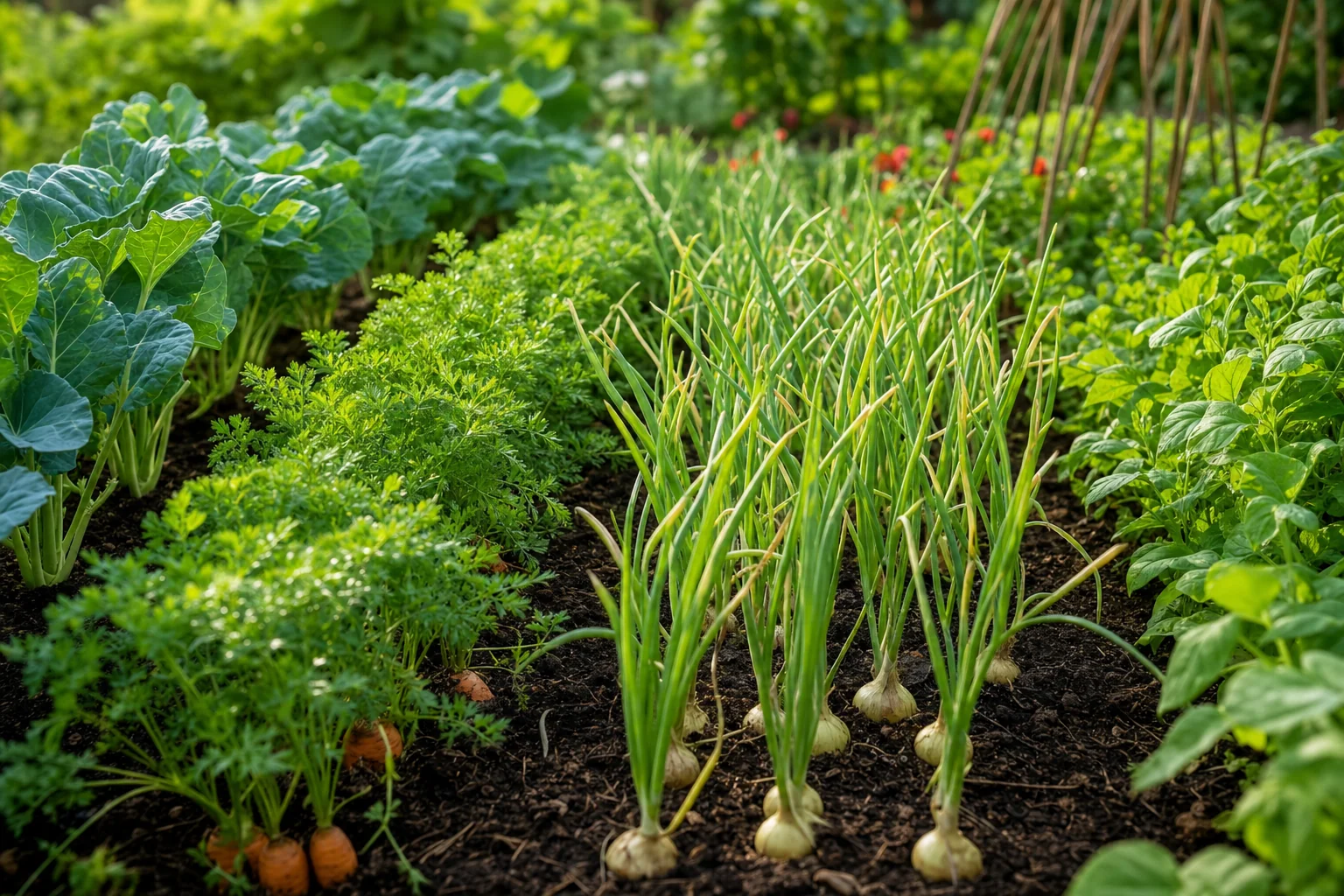
The onion companion plants that have worked best for us:

  • Carrots
  • Brassicas like cabbage, broccoli, kale, and cauliflower
  • Lettuce and other shallow greens
  • Beets
  • Tomatoes, in moderation
  • Strawberries, if spacing is sensible
  • Marigolds around the edges

And the plants I avoid putting right next to onions:

  • Beans
  • Peas
  • Asparagus
  • Sage, at least in tight beds
  • Other alliums in huge blocks year after year

That last one sounds odd because onions obviously grow near onions. But disease pressure builds when you run alliums in the same spot over and over. Ask me how I know.

Year two, we planted onions, leeks, and garlic in the same 4-by-12 bed because it looked neat on paper. By August the bed looked tired, the garlic had rust, and the onions never sized up the way they had the year before. Could’ve been weather. Could’ve been rotation. Could’ve been both. I don’t repeat that setup anymore.

If you’re starting from scratch, an Onion Sets Variety Pack is the easiest way to get a mixed planting going without babying seedlings under lights. The advantage is speed — sets take off fast in spring soil. The downside is that sets can bolt more easily than well-grown transplants, especially if the weather swings hot-cold-hot like ours did in 2023. See current price before you buy, because onion sets jump around a lot by season.

Carrots and onions: the pairing I keep coming back to

Carrots and onions are the classic pairing for a reason. Not magic. Useful.

The idea is simple: onion scent may confuse carrot rust fly, and carrot foliage may make it harder for onion pests to zero in. I’m careful with the word “may,” because I’m not standing in the garden with a tiny clipboard interviewing flies. But after three seasons of growing carrots in rows between onions, we had fewer chewed carrot shoulders than we did in our open carrot patch.

Not zero. Fewer.

The best layout we’ve used was in a 30-inch-wide bed:

  • One row of onions down each outside edge
  • Two rows of carrots inside
  • About 8 inches between carrot rows
  • About 6 inches between onions and carrots
  • Drip line running straight down the center

That bed was boring to look at in May and beautiful by July. The onion tops stood upright, the carrot foliage filled in low, and weeds had less open soil to enjoy. I still had to thin the carrots. Sorry. No companion plant fixes that little chore.

If you need seed, Carrot Seeds for Companion Planting are worth picking up early because the good varieties disappear right when spring gardeners wake up. The advantage of growing carrots from seed is obvious: cheap, lots of choice, and you can succession sow. The disadvantage is equally obvious if you’ve ever tried it in crusty soil — germination can be maddening. We’ve had the best luck covering the row with burlap or a scrap board for 5–6 days, then checking daily. Don’t forget and cook them. I did that once. Tiny carrot tragedy.

My carrot-and-onion timing

We plant onion sets or transplants as soon as the soil can be worked and isn’t clumping like brownie batter. Here, that’s usually late March or early April.

Carrots go in around the same time, but I’m more patient with them. Cold soil slows them down, and a hard crust after rain is worse than waiting a week. I rake the bed fine, water before sowing, seed shallow, then press the soil down with the back of a hoe.

Not stomp. Press.

Onions don’t seem to mind the carrot watering schedule early on, which is another reason this pairing works. Carrots need steady moisture to germinate. Onions appreciate not being abandoned in dry spring wind.

Brassicas are some of the better onion companion plants

Cabbage moths are the enemy of peace.

I’ve grown kale, broccoli, cabbage, collards, and Brussels sprouts next to onions. I still use row cover when I care about the crop — especially cabbage and broccoli — but onions seem to help make brassica beds less attractive. Or maybe the mixed planting just slows pests down. Either way, I’ll take it.

The strongest result we saw was with kale and onions along the same bed edge. The kale stayed cleaner than the kale in the bed across the path, which had no onions and got chewed into green lace by mid-June. Was it a controlled university trial? No. It was me muttering in the garden with coffee. But I noticed.

Spacing matters here. Brassicas get big. A broccoli plant does not care about your cute little companion planting diagram. It will lean, shade, flop, and act like it owns the place.

For broccoli or cabbage, I plant onions along the outer edge of the bed, not jammed between the main plants. Give the brassicas their 18–24 inches, depending on variety. Onions can run along the border at 4–6 inches apart.

With kale, I’m more relaxed. Kale is upright enough that onions can live closer, especially if you harvest lower leaves often.

But don’t expect onions to replace row cover. They won’t. In 2024, cabbage worms were ridiculous here after a mild winter. The onions helped, maybe, but the uncovered broccoli still needed hand-picking every other morning. Yellow eggs. Green worms. The whole circus.

Lettuce, spinach, and onions make good use of spring space

This isn’t the sexiest companion planting combo, but it’s practical.

Onions take a while to bulk up. Lettuce and spinach are fast. So we use onions as the long-season crop and tuck greens between or beside them early. By the time onions need more room, the lettuce is usually harvested or bolting.

This works especially well with leaf lettuce. Head lettuce can get too bulky unless you space generously. Spinach is fine, but in our beds it bolts so fast some years that I treat it like a spring snack, not a crop plan.

One setup I like:

  • Onion rows 10–12 inches apart
  • Lettuce seeded lightly between rows
  • Harvest lettuce young, before it shades the onion bases

Do not let lettuce become a wet mat around onion stems. That’s slug housing. We had that problem in 2022 after a rainy May. The onions were fine, but harvesting lettuce meant shaking out slugs like loose change.

Beets are decent neighbors, but not my first pick

Beets and onions grow together just fine for us. No drama. No obvious pest miracle either.

The reason I still use them together sometimes is root spacing. Beet roots swell below, onions bulb near the surface, and the leaves occupy different shapes. Beets flop outward more than carrots, so they can shade small onions if you plant too tight.

Give them room. I like beets in blocks, onions on the edge.

The downside is harvest disturbance. Pulling beets near onions can loosen onion roots if the soil is dry and hard. Water first or use a hand fork. Small thing, but it matters.

Would I call beets one of the best onion companion plants? Middle of the pack. Fine. Useful. Not amazing.

Tomatoes and onions: yes, but don’t overdo it

I know some gardeners plant onions all around tomatoes. We do a little of that, especially around the front edge of a tomato bed.

The benefit is mostly space use and scent diversity. Tomatoes are tall, onions are low, and both like decent fertility. But tomatoes are greedy. Once they hit their summer monster phase, they shade everything. Onions trapped under tomato foliage won’t size well.

We had a bed of paste tomatoes in 2021 where I planted onions too far inside the tomato row. Looked clever in April. By July those onions were sad little scallions under a jungle of Roma leaves. I pulled them early and used them green.

Now I keep onions on the sunny edge. South side, if possible. Four to six inches apart. And I don’t count on huge storage onions from that setup.

Marigolds with onions: useful on the border, not sprinkled everywhere

Marigolds are not fairy dust. I like them, but people overpromise them.

We plant marigolds at the corners or ends of onion beds, especially where onions are sharing space with carrots or brassicas. They bring in pollinators, add root diversity, and may help with certain soil pest issues depending on the species and situation. They also make the bed look less like a tiny onion factory, which counts for something when you walk past it every day.

Marigold Seeds (Pest Deterrent) are the product I’d buy if you’re already ordering carrot seed and onion sets. Advantage: they’re easy from seed, tolerate neglect, and fill gaps fast once the soil warms. Disadvantage: they can crowd small crops if you plant them like confetti. Keep them to edges and corners unless you’re growing a dedicated flower strip. See current price, and don’t feel like you need anything fancy.

French marigolds have done better for us than the giant African types in vegetable beds. The big ones are gorgeous, but they can shade low crops and flop after storms. A 10-inch marigold behaves. A 30-inch marigold starts making decisions for the whole bed.

Herbs that work near onions — and one I keep away

Parsley has been fine near onions. Dill too, if it’s not allowed to shade everything. Cilantro is useful in spring because it bolts right as onions are getting larger, and the flowers bring in beneficial insects.

Chamomile is one of those old companion suggestions for onions. I’ve grown them near each other and had no issues. Did the chamomile improve onion flavor? I have no idea. Anyone claiming they can prove that in a backyard bed is more confident than I am.

Sage is the herb I don’t love near onions in tight annual beds. Not because it attacks onions or anything dramatic. It just gets woody, spreads wider than expected, and wants a drier, more permanent home. Onions want steady moisture while sizing up. Sage doesn’t. Put sage in an herb border and let onions stay with the vegetables.

What not to plant near onions

Here’s where I’m less wishy-washy.

Don’t plant onions right next to beans and peas if you can avoid it.

Alliums — onions, garlic, leeks, chives — are often said to suppress legumes. The explanation usually has to do with effects on beneficial soil microbes and nitrogen-fixing bacteria. I’m not going to pretend I measured root nodules with lab equipment, but I’ve seen enough weak beans near onions to stop doing it.

The worst combo we tried was bush beans tucked beside overwintered onions. The onions were happy. The beans were not. They germinated unevenly, stayed smaller than the same variety in another bed, and produced less. Same seed packet. Same week. Same drip irrigation. Different neighbors.

Could there have been another factor? Sure. There always is. But I don’t have unlimited garden space for repeating mistakes.

Peas were similar, though less dramatic. They grew, but not with the lush, grabby energy I want from peas in April. Now peas go with lettuce, radishes, or carrots — not onions.

Keep onions away from asparagus beds too

Asparagus is perennial. Onions are annual or biennial depending how you’re growing them. The issue isn’t that onions poison asparagus. It’s disturbance.

Asparagus roots don’t want you digging around every season. Onions need planting, weeding, and harvesting. Those two lifestyles don’t match. I keep the asparagus bed boring: compost, mulch, asparagus, maybe a few shallow annual flowers near the edge. No onion harvest chaos in there.

The onion companion plants layout I’d use if I had one 4-by-8 bed

If you only have one raised bed and want onions, carrots, brassicas, and flowers in the same space, here’s a layout I’d actually plant.

Back/north side:

  • 3 kale plants or 2 broccoli plants, spaced properly
  • Onions along the outside edge, 4–6 inches apart

Middle:

  • Two carrot rows, 8 inches apart
  • One drip line or careful hand-watering path between them

Front/south side:

  • Another onion row
  • Leaf lettuce tucked between onions early in the season
  • Marigolds at two front corners

This gives everyone light. That’s the big thing. Companion planting fails when gardeners forget that plants are physical objects, not symbols on a chart.

A cabbage plant will shade carrots. A tomato will shade onions. A marigold can become a shrub if you picked the wrong type. Spacing is not optional.

For more layout ideas, I’d normally point folks to our broader companion planting guide here on Rude Insect, but since the internal link target wasn’t provided for this draft, I’m not inventing a URL. The short version: put tall crops north, low crops south, and don’t cram good companions so tightly they become bad neighbors.

Soil, water, and the boring stuff that matters more than folklore

Onions are not hard, but they are unforgiving about a few things.

They want loose soil. Not fluffy nonsense, just soil that lets bulbs expand. If your bed is compacted, onions will tell you by making little bulbs with thick necks. We loosen with a broadfork and add compost. I don’t add fresh manure before onions. Too much nitrogen late can push leafy growth when I want bulbs.

They want consistent water. Especially while bulbing. In our garden, that means drip irrigation with 1/2-inch mainline and 1/4-inch feeder lines in some beds, though I’ve also used simple soaker hoses. When onions dry out hard and then get soaked, they don’t always recover gracefully.

They want sun. Full sun. You can sneak scallions into part shade, but storage onions need light.

And they hate weed pressure. This is where carrots as companions can be a mixed blessing. Carrots take forever to look like anything, and weeds will happily impersonate the crop. I flame-weed carrot beds before germination sometimes, but only if I’m confident on timing. Otherwise, hand weeding it is. Knees in the path, coffee getting cold.

Starting with onion sets vs. seed vs. transplants

I’ve grown onions from seed, sets, and purchased transplants. All three work.

Sets are easiest. That’s why I recommend the Onion Sets Variety Pack for newer gardeners or anyone who missed the seed-starting window. You can get them in quickly and still have a respectable crop. The tradeoff is bolting risk and less control over exact variety.

Seed gives you the most choice. It’s also slow. You need to start early — late winter for us — and keep seedlings trimmed and lit. I like seed-grown onions, but I don’t always have the bandwidth in February when peppers and tomatoes are already hogging the lights.

Transplants are the middle road. Good if you have a local nursery that sells varieties suited to your day length. That part matters. Long-day, short-day, intermediate-day — onions care. In Pennsylvania, we grow long-day types. If you’re in Georgia planting the same onion I am, don’t blame the onion when it pouts.

My strongest recommendation

If I were planting one companion bed for reliability, I’d plant onions with carrots and edge it with marigolds. That’s the combo I’d defend.

Carrots make good use of the space between onion rows, onions may help confuse carrot pests, and marigolds bring in insect life without taking over if you keep them on the corners. It’s practical. It harvests well. It doesn’t require a spreadsheet.

Brassicas are my second choice, especially kale. But because brassicas bring heavier pest pressure and need more space, they’re slightly less foolproof.

Beans and peas stay elsewhere. Every year. No debate in our garden now.

Our Top Picks

📦

Onion Sets Variety Pack

Check Price Check Price →
📦

Carrot Seeds for Companion Planting

Check Price Check Price →
📦

Marigold Seeds (Pest Deterrent)

Check Price Check Price →

Frequently Asked Questions

What are the best onion companion plants?
The best onion companion plants in our garden have been carrots, kale, cabbage-family crops, lettuce, beets, and marigolds around the edges. If I had to pick one pairing, I’d choose carrots and onions because they share space well and seem to reduce pest confusion on both sides.
Can I plant onions next to carrots?
Yes. Carrots and onions are one of the most useful companion pairings we’ve grown. Plant onions in rows or along the bed edges, then sow carrots 6–8 inches away so both crops have room. Keep carrot seed moist until germination, and don’t let onion tops shade tiny carrot seedlings.
What should not be planted near onions?
Avoid planting onions right next to beans and peas. We’ve had weaker growth from legumes planted close to onions, and many gardeners report the same. I’d also keep onions out of asparagus beds because harvesting onions disturbs perennial asparagus roots.
Do onions repel pests from cabbage and broccoli?
Onions may help confuse some pests with their strong scent, but they won’t fully protect cabbage or broccoli. We still use row cover for brassicas when cabbage worms are bad. Think of onions as one layer of help, not a complete pest-control plan.
Can I plant marigolds with onions?
Yes, but keep marigolds on the edges or corners of the bed. They’re useful for attracting insects and adding diversity, but large marigolds can crowd onions if planted too closely. Smaller French marigolds have behaved better in our vegetable beds than tall types.
Are onion sets better than onion seeds?
Onion sets are easier and faster, especially if you’re planting in spring and didn’t start seeds indoors. Seeds offer more variety and control, but they take time and planning. For most new gardeners, onion sets are the simpler way to get a crop growing.