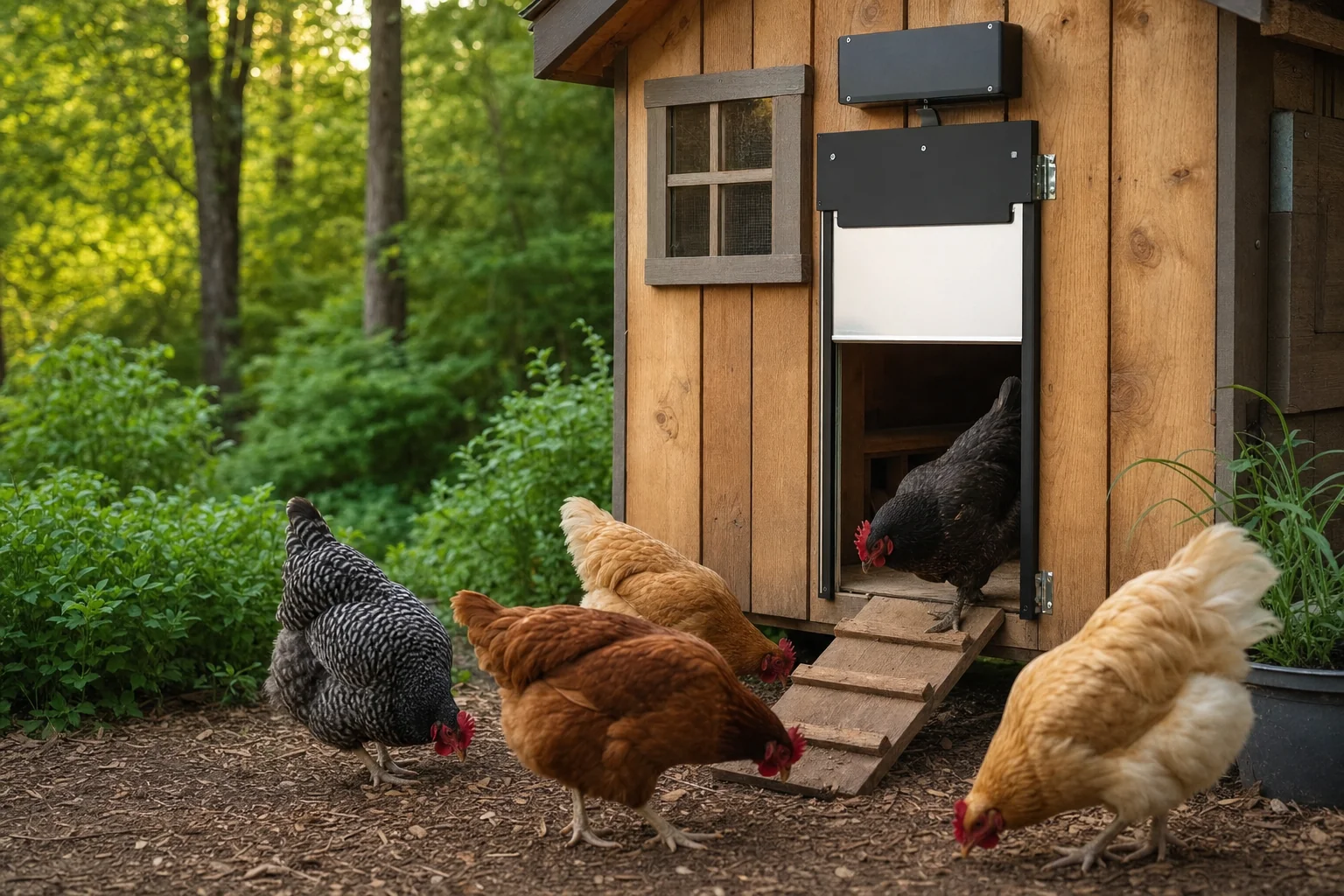
The Best Automatic Chicken Coop Doors in 2026 (Light vs Timer, Tested Through Winter)
Automatic coop doors tested through a cold winter — light-sensor vs timer, battery vs solar, and which ones jammed or failed in freezing weather. Which door
Like this garden guide? Subscribe to Rude Insect on YouTube for more hands-on growing videos.
Subscribe on YouTube
An automatic chicken coop door sounds like one of those gadgets you buy because you’re tired, then quietly regret by February. We’ve had both. The good ones let you stop sprinting outside at 9:14 p.m. in muck boots because somebody forgot to latch the pop door. The bad ones freeze half-open, close on a slow hen, or decide that a cloudy afternoon means bedtime at 3:40. We tested light-sensor and timer-style doors through a cold Pennsylvania winter — Zone 6b, single-digit nights, sideways sleet, one very rude raccoon — and I do have a favorite.
The automatic chicken coop door I’d trust in winter
If I had to put one automatic chicken coop door on a small backyard coop in 2026, I’d pick the Run-Chicken T50 Automatic Coop Door.
Not because it’s fancy. It isn’t. That’s part of why I like it.
The T50 is a compact door unit, so there’s less cable, less track, less “why is this tiny plastic pulley full of frozen bedding?” nonsense. The specific advantage is simplicity: it mounts cleanly on the coop wall, and there isn’t a big external control box dangling where chickens can peck it or where wind-driven rain can find a seam.
The disadvantage? You need to be comfortable checking the settings and batteries. Don’t install it in October and assume you’re done until tomato season. Battery doors are only as reliable as the person who remembers to check them before a cold snap.
We tested a timer setup against a light-sensor routine, and timer won for our yard. Not by a mile. But enough.
Our coop sits near a line of Norway spruce, and the winter sun drops behind them early. A light sensor sees shade, not your predator schedule. The hens, meanwhile, are still scratching around the run like it’s a spa day. That’s how you end up with a door closing while two birds are standing outside blinking at it.
Timer mode is boring. Boring is good when you’re trying to keep raccoons out.
Light sensor vs timer: where the automatic chicken coop door argument gets real
I wanted to love light sensors. I really did. They sound perfect on paper because daylight shifts all year, and nobody wants to adjust a timer every few weeks.
But chickens don’t read the brochure.
Here’s what happened in our setup:
- On bright, clear evenings, the light-based closing time was pretty good.
- On heavy overcast days, it tried to close too early.
- During snow cover, the reflected light made dusk behave oddly.
- Under tree shade, the sensor thought the day was ending before the hens agreed.
And — important — a light sensor mounted on the shady side of a coop is not judging the same sky your chickens are living under. I learned that the annoying way.
The timer had its own chores. In November, we bumped closing earlier. In March, later. I keep a note in my phone now: “Check coop door time — first Sunday of month.” That’s not romantic homesteading. It works.
If your coop is in an open pasture with clean exposure to the western sky, a light sensor may behave better for you. Honestly, your mileage may vary. Our coop is tucked behind the garden fence, near compost bins, a stack of oak slabs, and a lilac that should’ve been pruned five years ago. Not ideal sensor territory.
For more on placing coops where weather and predators don’t punish you, I’d pair this with our backyard chicken coop setup guide. Door choice matters, but location does half the work.
What failed first: ice, bedding dust, and lazy maintenance
The first automatic door we tried years ago wasn’t one of the current picks. It was a cheap track-style door with a cord lift. I won’t name it because it’s no longer sold, but the lesson stuck.
It worked beautifully in September.
By January, the vertical tracks had packed with fine bedding dust. Then we got freezing rain. Then the whole thing made a sad grinding noise and stopped about three inches from closed. Three inches is plenty for a weasel.
That was the night I went out at 11:30 with a headlamp, a flathead screwdriver, and pajama pants tucked into barn boots. Very glamorous.
Since then, I look at automatic doors differently. I care less about shiny features and more about these boring details:
- Can ice collect where the door slides?
- Can pine shavings wedge under the closing edge?
- Is the battery compartment easy to reach with gloves on?
- Can I override it manually without reading a 19-page booklet?
- If it fails, does it fail open, closed, or half-open?
That last one matters. A door that fails half-open is worse than no automatic door because you think the flock is protected when it isn’t.
Run-Chicken T50 Automatic Coop Door: the one I’d install again
The Run-Chicken T50 Automatic Coop Door is my pick for most backyard flocks because it keeps the whole system tidy. Fewer exposed moving parts. Cleaner install. Less opportunity for bedding dust and ice to make trouble.
Specific advantage: it’s compact enough for small coops where a bulky frame or separate motor box would be awkward. If you’ve got a homemade 4-by-6 coop or a prefab coop with limited wall space, that matters.
Specific disadvantage: battery-dependent gear needs regular checks. Cold eats batteries faster than mild weather. That’s not a defect so much as physics being annoying. I check ours every other weekend in winter, usually while I’m topping off heated waterers.
I also like that this style of door doesn’t require running an extension cord across the yard. We tried that once for a heated water base and I hated it. The cord got stiff in the cold, the GFCI tripped during wet snow, and I spent way too much time wondering whether the orange cord was about to get chewed by something with tiny teeth.
Would I trust the T50 on a coop that’s 400 feet from the house, where I only check birds every few days? No. But I wouldn’t keep chickens that way either. Even the best automatic chicken coop door is not a substitute for eyeballs on the flock.
The door is a helper. Not a farmhand.
OverEZ Solar Automatic Chicken Coop Door: best if power is your problem
The OverEZ Solar Automatic Chicken Coop Door makes sense for a different kind of setup: a coop away from the house, no nearby outlet, and enough sun exposure to keep solar practical.
Specific advantage: solar charging can save you from battery anxiety, especially if your coop sits in an open area and gets real winter sun. If you’re running birds in a pasture coop or a back-lot setup, that’s attractive.
Specific disadvantage: solar depends on placement and weather. A panel mounted where snow sits on it for three days is just a decorative rectangle. Same with a panel shaded by the coop roof after 2 p.m.
We tested solar on a small utility setup before using it on poultry equipment, and the pattern was always the same: great in May, fussy in December. Not useless. Just fussy. If you’re the sort of person who already brushes snow off greenhouse panels and checks fence chargers, you’ll be fine. If you want a set-it-and-forget-it door, solar may annoy you.
I’d use the OverEZ solar door for a coop with a clear southern exposure. I would not tuck it under a maple tree and expect miracles.
And if your predator pressure is high — raccoons, foxes, stray dogs, the whole cast — check the door after every ugly storm. Solar doesn’t excuse inspection.
The coop itself can make or break the door
This is the part people skip. They’ll spend hours comparing an automatic chicken coop door, then mount it on a flimsy wall that flexes every time the wind hits.
A door needs a square, solid opening. If the wall bows, the door can bind. If the pop-hole cut is ragged, bedding catches. If the coop sits out of level, the door may not travel cleanly.
Prefab coops vary a lot here. Some are fine for a small flock if you reinforce the weak spots. Some are basically dollhouses with nesting boxes.
The AECOJOY 123” Large Chicken Coop with Run is worth looking at if you need a coop-and-run footprint rather than just a sleeping box. Specific advantage: the included run gives you a contained area to work with, which helps if you’re adding an automatic door and want birds funneled to the same entrance every night. Specific disadvantage: with any prefab run, I’d still inspect the hardware cloth situation, latches, and ground-level predator protection before trusting it overnight. Raccoons have hands. Tiny criminal hands.
The AECOJOY 95” Wooden Chicken Coop is the kind of smaller wooden coop that can work for a modest backyard flock, assuming you’re realistic about bird count. Specific advantage: wood is easy to modify, so cutting or reinforcing a pop-door opening is usually simpler than fighting thin metal panels. Specific disadvantage: small prefab coops often need extra sealing, better screws, or added bracing after a season of rain and freeze-thaw.
The AECOJOY 96” Chicken Coop with Wheels is more interesting if you move birds onto fresh ground. Specific advantage: wheels let you shift manure load and scratching pressure around the yard instead of creating one permanent mud crater. Specific disadvantage: mobile coops can sit slightly uneven after every move, and that matters for an automatic door. Check that the door still opens and closes freely after you relocate it. Every time. Annoying, yes. Better than finding the door stuck at dusk.
If you’re still deciding between stationary and movable housing, our backyard chicken coop setup guide has the stuff I wish we’d known before building our first run too low to stand in. My back remembers.
Battery vs solar vs plug-in for an automatic chicken coop door
Plug-in doors sound reliable until you remember outdoor electricity is a whole little project. You need safe routing, weather protection, and ideally a setup that doesn’t trip every time rain blows sideways. For a barn with proper power, fine. For a backyard coop across wet grass? I’m not a fan.
Battery is my default choice for most people. Simple. Clean. No trenching. No panel placement. The downside is maintenance, especially in freezing weather. I write the battery check date on blue painter’s tape inside the coop because I will absolutely forget otherwise.
Solar is good when the site is right. Not sort-of right. Actually right. Full sun. Panel angled so snow slides or can be brushed off. No deep shade from the roofline. No “it gets sun in summer” logic — winter sun is lower and meaner.
Here’s my rough preference:
For a backyard coop near the house: battery door.
For a remote coop with strong sun: solar door.
For a barn or shed with safe existing power: plug-in can make sense, though I’d still want a backup plan.
The backup plan can be as simple as a manual latch and a reminder to check the door before bed when weather gets stupid.
Cold-weather testing notes: what I actually watched for
We had our usual winter mess: nights around 12°F, a couple dips lower, wet snow, dry powder, thaw, refreeze. The worst conditions for coop doors aren’t always the coldest nights. It’s the wet afternoons followed by a hard freeze.
That’s when moisture gets into tracks, seams, and bedding. Then everything locks up like a forgotten garden hose nozzle in January.
I checked doors at three times:
Morning, to see if they opened cleanly.
Late afternoon, to see if birds were near the entrance before close.
After dark, to confirm the door was fully shut.
That last check is the one people don’t want to do because they bought the door to avoid going outside after dark. I get it. But for the first week after installing any automatic chicken coop door, do the dark check. After storms too.
We had one near-miss with a hen named Pickle, who believes rules are for other chickens. She stood outside the opening scratching at nothing while the door began its close routine. The safety behavior on modern doors is better than the old junky one we used years back, but I still don’t like relying on a sensor to understand a chicken with one brain cell and a personal agenda.
So we set closing time later than technically necessary. Predators move at dusk, yes. But locking out a hen is also bad. Our compromise is to close after the birds have reliably gone in, then use good run fencing as the first predator layer.
Predator protection: the door is only one piece
A strong automatic door helps, but it won’t save a weak coop.
Our raccoon problem year was 2021. They tested every latch on the run, pulled at corners, and left muddy handprints on the nest box lid. Charming little nightmares.
What worked:
- Two-step latches on access doors
- 1/2-inch hardware cloth, not chicken wire, around vulnerable areas
- Apron fencing at ground level
- No feed left in open bowls overnight
- A door that fully closes before full dark
What didn’t work: a cute little barrel bolt latch. Raccoon opened it. I’m still offended.
If you’re adding an automatic chicken coop door, take ten minutes and pretend you’re a raccoon. Pull the corners. Push the pop door. Wiggle the run panels. Look for gaps bigger than they seem. Predators don’t need the whole wall to fail. They need one soft spot.
And if you have a prefab coop, upgrade the latches before you upgrade the gadgets. I mean that.
Installation mistakes that cause jams
Most door problems I’ve seen weren’t really product failures. They were installation sins.
The door was mounted crooked.
The opening had splinters.
The screws were overtightened and warped the frame.
The threshold collected shavings.
The birds kicked bedding against the door every day until it dragged.
We did the bedding one ourselves. Our pop door was too close to the coop floor, and the hens scratched pine shavings into the track area like they were being paid by the hour. I added a small wooden lip inside the doorway — about 1 1/2 inches high — and that fixed most of it.
Not all. Chickens are chaos in feather form.
Before mounting, I like to dry-fit the door and run it several times while I’m standing there. Then I run my hand around the opening for rough edges. If I wouldn’t drag a sleeve across it, I don’t want a door sliding there twice a day.
Use exterior screws. Pre-drill if the coop wood is thin. And don’t mount the control area where roof runoff dumps water over it. Sounds obvious. You’d be surprised what you miss when you’re installing something at 4 p.m. with chickens climbing the ladder.
Which automatic chicken coop door kept the flock safest at dusk?
For our yard, the Run-Chicken T50 Automatic Coop Door kept the routine most consistent because timer control fit our messy light conditions. It didn’t need perfect sun, didn’t require a cord, and didn’t have the bulky track-style setup that gave us trouble years ago.
The OverEZ Solar Automatic Chicken Coop Door is the one I’d choose for a sunnier, more remote coop where battery checks are a pain and panel placement is easy. I like the idea. I just wouldn’t put it in our shaded winter corner and expect it to behave perfectly.
So my actual recommendation is this: buy the Run-Chicken T50 for a normal backyard coop, especially if your coop sits near trees, fences, sheds, or anything else that makes light sensors moody. Use timer mode. Check batteries. Set closing a little later than the first night you think you can get away with.
Then spend the extra hour predator-proofing the run.
That hour matters more than any button on the door.
A quick buying checklist before you order
Measure the pop-hole opening. Not “about right.” Measure it. Width, height, and the flat wall space around it.
Check how your coop wall is built. Thin prefab siding may need a backing board so the door mounts solidly. A scrap of 1/2-inch exterior plywood can turn a wobbly install into a decent one.
Watch your chickens for three evenings before setting the timer. Some flocks march in early. Some have one hen who wants to watch the moonrise like a poet. Build your schedule around the last bird, not the first.
Think about winter access. Can you reach the battery compartment with gloves? Can you clear snow from the door? Can you see the door from the house with a flashlight?
And please don’t skip the manual test. Open it. Close it. Do that ten times before trusting it. We test irrigation timers the same way in the garden because the one you don’t test is the one that floods the onion bed while you’re buying feed.
Same principle. Wetter consequences in the garden. Feathery consequences here.
Our Top Picks
AECOJOY 123'' Large Chicken Coop with Run
AECOJOY 95" Wooden Chicken Coop