Olle vs Land Guard Raised Beds: Compare Height and Fill Cost
Compare Olle's 32-inch 12-in-1 and Land Guard's 12-inch 8-by-4-foot bed by usable dimensions, soil volume, access, support, and total delivered cost.
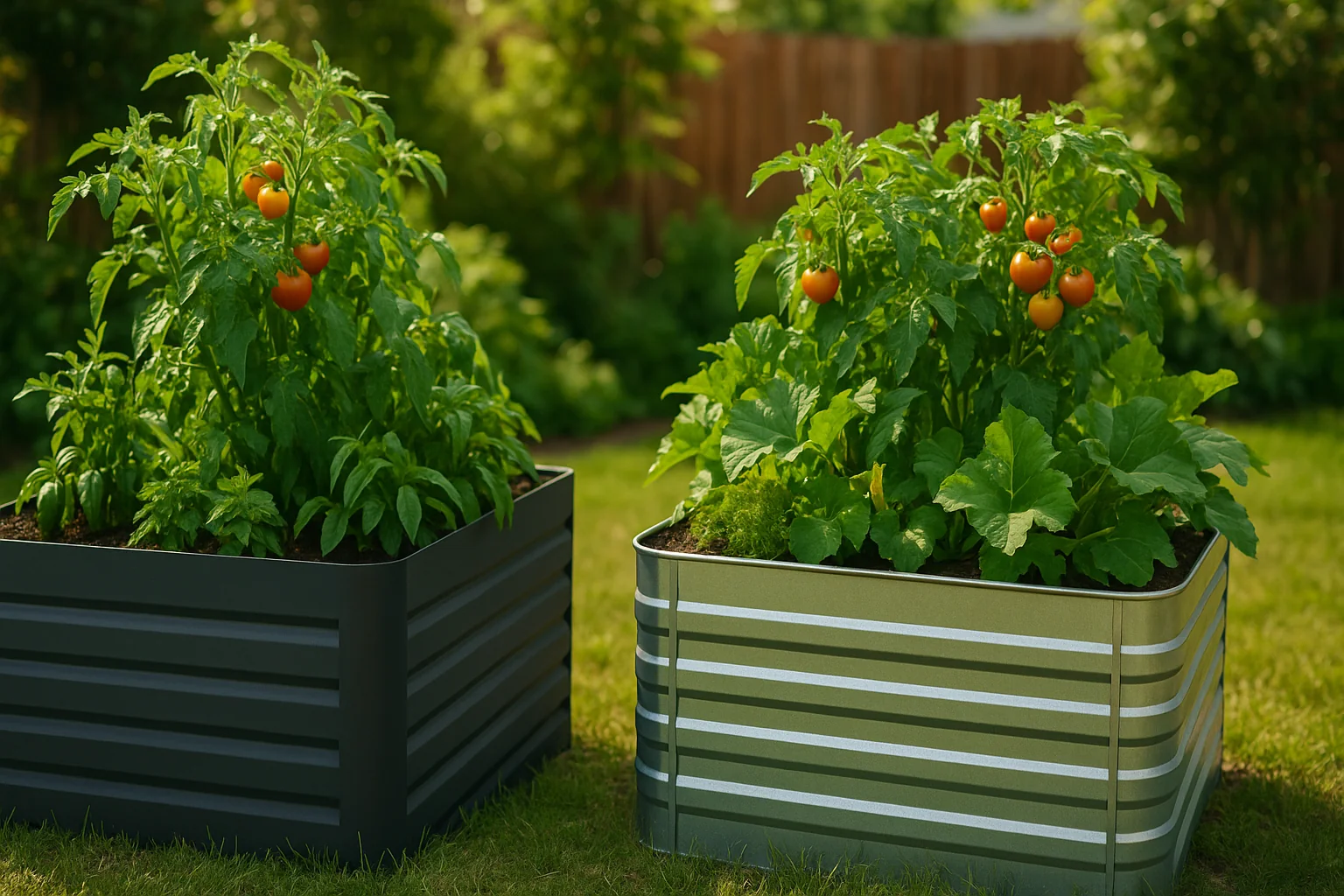
Choose between these two metal raised beds by working height, modular footprint, and total soil fill cost before comparing the carton price. The Olle Gardens 32-inch Tall 12-in-1 modular kit provides an elevated, waist-level gardening surface with curved Aluzinc-coated panels that configure into twelve footprints (such as 80 by 40 inches). The Land Guard 12-inch Rectangular 8-by-4-foot bed offers a low-profile galvanized frame with a larger 32-square-foot surface footprint that requires far less soil per square foot to fill. A 32-inch wall reduces bending, but filling a 32-inch bed takes 2.67 times as much soil per square foot as a 12-inch bed—making bulk soil and delivery a major part of the real budget.
Compare Exact Models
| Field | Olle 32-inch Tall 12-in-1 | Land Guard 12-inch Rectangular |
|---|---|---|
| Published height | 32 inches | 12 inches |
| Layout | Modular; twelve published configurations | Listed as 8 × 4 feet (rectangular) |
| Example dimensions | Option 1: 80 × 40 inches (~6.67 × 3.33 ft) | Nominal 96 × 48 inches (8 × 4 ft) |
| Planting area from that rectangular outline | About 22.2 square feet | 32 square feet |
| Fill at full nominal height, before curvature or headspace | About 59.3 cubic feet (~2.20 cubic yards) | 32 cubic feet (~1.19 cubic yards) |
| Published coating description | Zinc-aluminum alloy (Aluzinc) over corrugated steel | Galvanized corrugated steel |
| Reason to consider | Higher working surface and a choice of twelve modular footprints | More planting area in this comparison with a shallower, lower-cost fill |
| Reason to pass | Much higher fill volume per square foot and a taller wall to reach over | Low 12-inch wall does not solve bending or standing-access difficulties |
Olle’s dimensions come from its 32-inch 12-in-1 product chart. Land Guard’s current catalog lists the rectangular 8 × 4-foot model at 12 inches high. The volume and area calculations above are rectangular geometric estimates before accounting for corner radius and top mulch headspace.
These two kits represent different footprints and heights, not an equal-size durability contest. Olle’s current chart includes an eight-foot-long configuration that is two feet wide (96 by 24 inches), so do not turn “eight feet long” into an assumed 4 × 8-foot bed. Likewise, when browsing Land Guard listings, carefully distinguish between oval-end and flat-corner rectangular kits, as well as single beds versus two-pack bundles.
Corrugated Panel Steel Gauge and Structural Rigidity
When wet soil freezes, expands, or settles after heavy irrigation, it exerts outward lateral earth pressure against the side walls of a raised bed. Metal raised bed manufacturers counter this outward force through two structural variables: corrugation profile depth and sheet steel thickness (gauge).
In the standard sheet-metal gauge scale used for steel, a lower gauge number indicates thicker metal (for example, 22-gauge steel is thicker than 24-gauge or 26-gauge steel). However, marketplace listings frequently omit exact base-metal thickness, confuse coated total thickness with bare steel thickness, or vary across production batches.
- Why corrugation geometry matters: Deep, closely spaced horizontal ribs act like miniature I-beams running along the length of each side panel, resisting bending along the horizontal axis far better than flat sheet metal of the same thickness.
- Height multiplies wall stress: A 12-inch bed holds only one vertical foot of damp soil, so lateral bulging pressure at the midpoint of the wall is modest. A 32-inch bed holds nearly three vertical feet of wet soil; lateral pressure increases markedly in the lower half of the wall, requiring thicker steel, curved corner transfer, and internal tension rods to keep the long sides from bowing outward into an oval shape.
- Verification before ordering: RudeInsect has no verified equal-method micrometer measurements, salt-spray comparison, or freeze-thaw trial for these exact units. Do not base a purchase on an unverified blog gauge number; check the current manufacturer specification sheet for panel thickness and required internal bracing.
Aluzinc vs. Standard Galvanized Steel Coatings
Both Olle and Land Guard use coated carbon steel rather than bare steel, which would rust rapidly in moist, slightly acidic garden soil. However, their catalog descriptions refer to two distinct metallurgical coating categories:
| Coating Attribute | Zinc-Aluminum Alloy (Aluzinc / Galvalume-Type) | Standard Hot-Dip Galvanized Steel |
|---|---|---|
| Published Brand Usage | Olle describes its panels as corrugated steel protected by an Aluzinc coating with food-grade exterior paint | Land Guard describes its budget rectangular and oval beds as galvanized metal |
| Typical Alloy Composition | Commonly formulated around 55% aluminum, ~43.4% zinc, and ~1.6% silicon by weight in industrial sheet standards | Primarily zinc coating bonded to the steel substrate |
| Barrier vs. Sacrificial Protection | Aluminum forms a dense oxide barrier against moisture, while zinc offers sacrificial cathodic protection at cut edges | Zinc acts primarily as a sacrificial anode that corrodes preferentially before the underlying steel |
| Soil Contact Considerations | Highly alkaline amendments (such as fresh wood ash or hydrated lime) or constantly waterlogged anaerobic soil can accelerate wear on any metallic coating | Thinner commercial zinc coatings can show white oxidation (“white rust”) if stacked wet prior to assembly or exposed to corrosive fertilizers |
While metallurgical literature shows that zinc-aluminum alloy coatings generally resist atmospheric and wet-dry corrosion longer than thin commercial zinc galvanizing of equal thickness, catalog descriptions alone do not establish a verified lifespan difference for two specific retail kits without coating-weight data (such as G90 vs. AZ50) and paint film specifications. Never assume a scratched panel “self-heals” indefinitely: inspect panels upon delivery, avoid dragging panels across concrete driveways during assembly, and ask the manufacturer what touch-up coating is safe if a panel arrives gouged down to bare metal.
Corner-Panel vs. Flat-Panel Modular Assembly and Cross-Rod Bracing
Beyond wall height, Olle and Land Guard differ in how their panels join at the corners and how they resist outward soil bowing along long straight runs.
Curved Modular Panels (Olle 12-in-1 System)
Modular 12-in-1 kits such as the Olle 32-inch bed pack a set of curved corner panels and flat straight extension panels into one carton. By rearranging how many straight panels sit on the sides versus the ends, you can build twelve different footprints—ranging from a compact capsule to a long, narrow border bed—using the same bolts, washers, and nuts.
- Corner strength: Rounded 90-degree corner panels distribute outward soil pressure continuously around the curve rather than concentrating force on a separate thin L-bracket.
- Fastener count: Because a 32-inch-tall modular bed stacks multiple horizontal bolt holes along every vertical seam, expect to fasten dozens of stainless or zinc-plated bolts, washers, and nuts. Using a socket wrench or nut driver while leaving seams finger-tight until the full ring is squared on level ground prevents misaligned holes.
- Top safety trim: Confirm that the kit includes a continuous flexible rubber or vinyl safety trim strip that presses over the top metal edge, and check how it is secured so summer sun does not shrink or pull it loose at the corners.
Rectangular Corner-Bracket Assembly and Cross-Rod Bracing (Land Guard 8 × 4)
A fixed 8-by-4-foot rectangular bed uses flat corrugated side panels joined at 90-degree corners, typically with overlap seams or corner brackets, plus internal cross-bracing rods spanning the 4-foot width between the two 8-foot walls.
- Why cross-rods are mandatory on 8-foot runs: Without tension rods tying the left and right walls together at the midpoint, filling an 8-foot-long metal bed with wet compost and topsoil pushes the center of the long panels outward by several inches.
- Installation order: Always install the manufacturer-supplied cross-rods or bottom/mid-wall stabilizing bars before shoveling soil into the frame. Once 32 cubic feet of damp soil has bowed the side walls outward, pulling the walls back together by hand to thread a brace bolt can strip threads or tear mounting holes.
- Working around braces: Note the height of internal cross-rods when planning rotary cultivation, broadforking, or lifting large root crops; never unbolt a cross-rod while the bed is full of soil, and never substitute an unrated piece of wire or PVC pipe for a structural tension bar.
When Olle Makes More Sense
Shortlist the taller Olle 32-inch 12-in-1 kit when bending down to a 12-inch frame is uncomfortable, you have verified your arm reach over a 32-inch rim, and one of its twelve published configurations fits your yard layout. Select the exact configuration from the manufacturer chart before ordering drip manifolds, cold-frame hoops, or animal-barrier mesh panels, since changing a modular bed’s footprint after filling requires shoveling out tens of cubic feet of soil.
A 32-inch wall does not automatically guarantee effortless access for every gardener:
- Standing vs. seated reach: For a standing adult, a 32-inch rim sits near hip or waist height, eliminating deep knee bends during planting and harvesting. However, for a shorter gardener or someone gardening from a wheelchair, reaching over a 32-inch solid wall toward the center of a 40-inch-wide bed can strain the shoulders because there is no knee clearance underneath the side wall. Test the geometry by setting a cardboard box or tape line at 32 inches high and reaching 20 inches inward before purchasing.
- Rooting depth vs. ergonomic height: Do not buy a 32-inch bed solely because you want to grow deep-rooted crops like indeterminate tomatoes or parsnips. As Utah State University Extension’s raised-bed gardening guidance explains, most vegetables root well in a 6- to 12-inch frame when the bed has an open bottom and the underlying native soil is loosened and uncontaminated. A 32-inch metal bed is primarily an ergonomic and aesthetic investment, or a solution for setting a bed over hardpan, tree roots, or gravel where roots cannot penetrate below the frame.
When Land Guard Makes More Sense
Shortlist the lower Land Guard 12-inch 8 × 4-foot bed when your primary goal is enclosing a generous 32-square-foot growing area at a low entry price, you have two-sided pathway access around the 4-foot width, and bending or kneeling next to a 12-inch wall is comfortable.
Treat this as a practical use-case match rather than a guarantee of a specific number of seasons. RudeInsect cannot substantiate claims that a budget 12-inch galvanized bed will fail in a fixed number of years or that its corner fasteners are inherently defective. Instead, inspect the seller’s current manual, included cross-bracing rods, top edge protection, return window, and replacement-part support upon delivery. A bargain marketplace listing that arrives missing panels or cross-braces is not a real saving unless the seller replaces missing hardware promptly.
Cubic-Foot Soil Volume Calculations: 12-Inch vs. 17-Inch vs. 24-Inch vs. 32-Inch Heights
At any identical ground footprint, soil fill volume scales directly with wall height. Filling to 32 inches requires 2.67 times as much material as filling to 12 inches, 1.88 times as much as 17 inches, and 1.33 times as much as 24 inches. That is pure geometry, not a brand-specific claim.
Calculate rectangular volume before ordering bulk or bagged soil:
Volume in cubic feet = Inside Length (ft) × Inside Width (ft) × Fill Depth (ft)
Volume in cubic yards = Cubic Feet ÷ 27
To see how height and layout affect soil budgets across standard raised bed sizes, compare the calculated fill volumes below:
| Footprint & Dimensions | 12-Inch Height (1.0 ft) | 17-Inch Height (~1.42 ft) | 24-Inch Height (2.0 ft) | 32-Inch Height (~2.67 ft) |
|---|---|---|---|---|
| Olle Option 1 Outline (80 × 40 in / ~22.2 sq ft) | 22.2 ft³ (0.82 yd³) | 31.5 ft³ (1.17 yd³) | 44.4 ft³ (1.65 yd³) | 59.3 ft³ (2.20 yd³) |
| Narrow Fence Layout (96 × 24 in / 16.0 sq ft) | 16.0 ft³ (0.59 yd³) | 22.7 ft³ (0.84 yd³) | 32.0 ft³ (1.19 yd³) | 42.7 ft³ (1.58 yd³) |
| Compact Bed (72 × 36 in / 18.0 sq ft) | 18.0 ft³ (0.67 yd³) | 25.5 ft³ (0.94 yd³) | 36.0 ft³ (1.33 yd³) | 48.0 ft³ (1.78 yd³) |
| Standard 8 × 4 ft Rectangle (32.0 sq ft) | 32.0 ft³ (1.19 yd³) | 45.3 ft³ (1.68 yd³) | 64.0 ft³ (2.37 yd³) | 85.3 ft³ (3.16 yd³) |
Note: Exact fill quantities vary slightly based on rounded modular corner radii, leaving 1 to 2 inches of watering headspace below the top rim, and soil settling (typically 10% to 15% over the first watering cycles).
Price the growing media and local bulk delivery fee before buying a 24-inch or 32-inch bed. Buying 60 cubic feet of soil in 1.5-cubic-foot retail plastic bags requires 40 separate bags, which often costs more than the metal bed itself. Use our tall-bed filling guide and raised-bed soil mix guide to plan the active top 12 to 18 inches of topsoil-compost blend and decide whether inert subsoil or coarse organic layers make sense in the bottom half of a 32-inch frame. Avoid filling the active upper root zone with raw wood chips, which tie up soluble nitrogen as microbes decompose the carbon.
Complete Pre-Purchase Quote Checklist
| Cost or Specification | Olle 32-Inch 12-in-1 Quote | Land Guard 12-Inch 8 × 4 Quote |
|---|---|---|
| Exact Item & Layout | 32-inch 12-in-1 kit; confirm chosen footprint from the 12-layout chart | 12-inch rectangular 8 × 4 ft; confirm single unit vs. multipack and flat vs. oval ends |
| Shipping & Tax | Kit shipping, tax, and heavy-carton delivery terms | Kit shipping, tax, and delivery conditions |
| Bulk or Bagged Fill | ~59.3 ft³ (for 80 × 40 in layout) plus 10–15% settling allowance | ~32.0 ft³ (for 96 × 48 in layout) plus 10–15% settling allowance |
| Bracing & Hardware | Included stainless/coated bolts, safety edge trim, and stabilizing rods | Included cross-bracing rods, corner brackets/bolts, and edge trim |
| Warranty & Parts | Written warranty terms, return shipping policy, and spare-panel availability | Written warranty terms, return policy, and missing-hardware replacement support |
Do not assume that a seasonal promotion, free shipping threshold, warranty duration, or delivery estimate applies to every color variant and zip code. Compare the total delivered project cost—frame plus soil—rather than the headline box price alone.
After installation, inspect the top protective trim, bolt tightness, cross-bracing rods, and side-wall plumbness before each planting season. Keep walkways at least 24 to 36 inches wide for wheelbarrow access, and never sit or stand on the top edge of a corrugated sheet-metal wall.
We may earn a commission if you buy through a link.
For additional modular comparisons at mid-range heights (15 inches vs. 17 inches), read our Vego vs Birdies comparison. If one of the two heights in this guide fits your garden plan, search Amazon for Olle’s 32-inch 12-in-1 or search Amazon for Land Guard’s 12-inch rectangular 8 × 4. These links open search results; always verify the exact height, configuration chart, and seller details on the resulting product page before ordering.
Products in this guide
Olle Gardens 32-inch Tall 12-in-1 Raised Garden Bed
Amazon search for the tall modular kit. Match the seller's configuration chart and included supports; this is not a fixed 4-by-8-foot bed.
Find matching listings on Amazon →Search results may include other models. Check the model and size before buying.
Land Guard 12-inch Tall Rectangular 8-by-4-foot Raised Bed
Amazon search for the rectangular one-foot-high model. Confirm shape, height, quantity, and actual dimensions before comparing offers.
Find matching listings on Amazon →Search results may include other models. Check the model and size before buying.