Vego Garden vs Birdies Aussie Beds: 18-Month Side-by-Side Review
We ran a Vego 17x32 and a Birdies 8-in-1 side by side for 18 months. Here's how they actually compare on assembly, durability, soil, heat, and price.
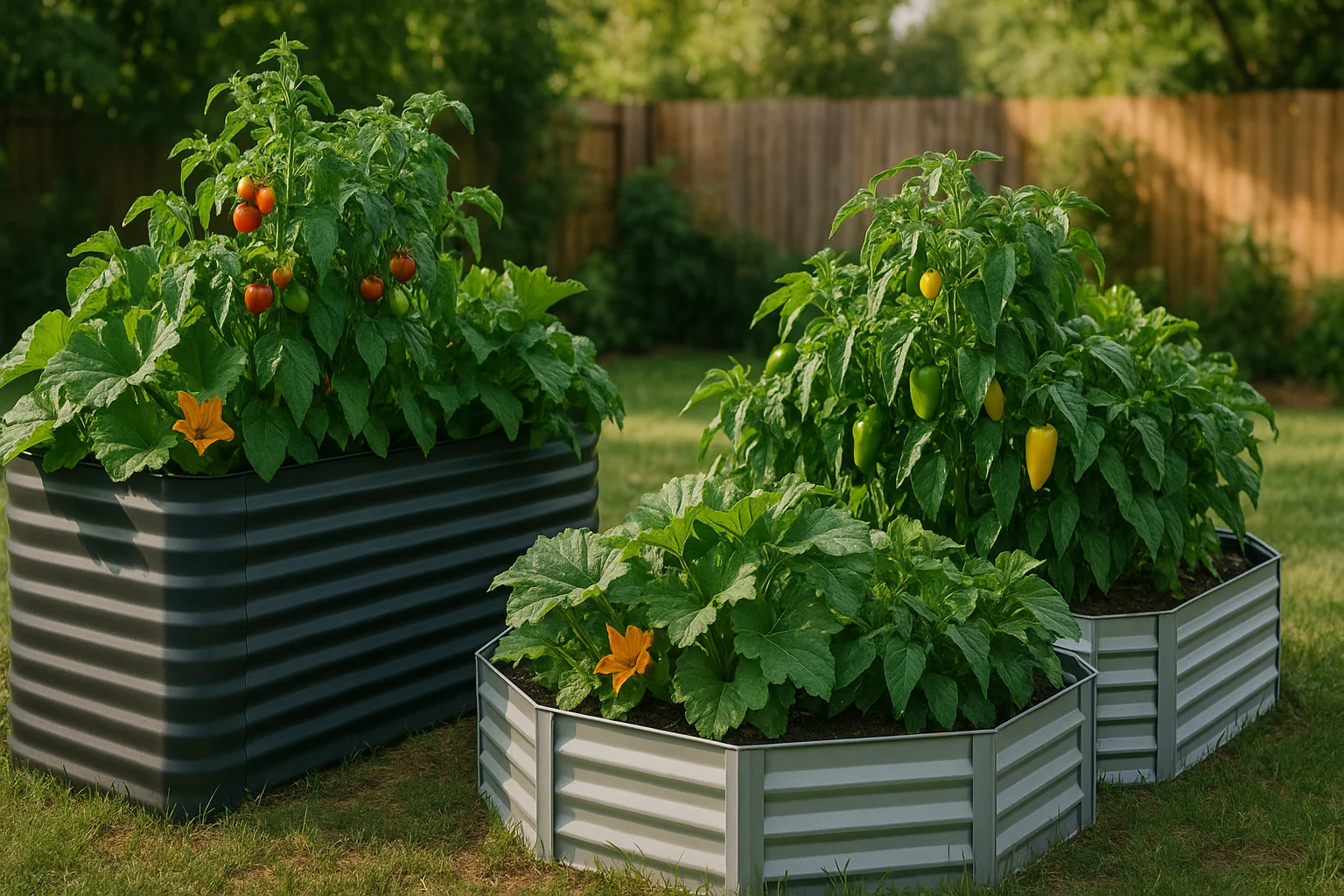
Eighteen months ago we did something most raised-bed reviews don’t bother with: we bought one of each, put them in identical positions, filled them the same way, planted the same crops, and watched what happened. No 30-day rush job, no Amazon-screenshot ranking. Just two beds, two seasons, two winters.
This is the result. If you’ve been bouncing between our pillar review of the best raised garden beds for 2026 and trying to pick between the two metal-bed giants, this is the deep dive.
The setup
Both beds went into the same 14-foot strip of our test garden in southeastern Pennsylvania, full south-facing sun, six to eight hours a day depending on the season. We bought:
- Vego Garden 17” x 32” Tall 9-in-1 — the modular metal bed that exploded on gardening TikTok in 2024.
- Birdies 8-in-1 Modular (29” Tall) — the original Australian design that Epic Gardening imports and sells in the US.
Both filled the same way: hugelkultur bottom (logs, leaves, cardboard), middle of half-finished compost and aged manure, top 10 inches of Coast of Maine compost mixed 50/30/20 with topsoil and perlite. Identical drip irrigation on a single zone. Same crops, rotated identically.
Then we just gardened.
Assembly: who wins out of the box
We assembled both solo, with one cordless drill, on the same Saturday morning.
Vego: 38 minutes. The panels are pre-curved at the corners, so you don’t fight a sheet of flat steel into a circle. Bolts came with phillips heads, which is mildly annoying — we swapped them for stainless hex bolts for the second bed we bought later. Instructions are picture-only, which actually works fine.
Birdies: 54 minutes. Heavier-gauge steel means heavier panels, and the bolt holes were a hair tighter — twice we had to wiggle a panel to seat a bolt. The included hardware is heavier and feels like industrial fasteners. We genuinely wished we’d had a second person to hold panels upright.
Winner on assembly: Vego, by enough to matter for a solo gardener.
Build quality and gauge
This is where the price difference shows up.
Tap the side of a Vego panel and it makes a thin metallic ping. Tap a Birdies panel and you get a heavier thunk. Both are food-grade Aluzinc-coated steel, but Birdies uses a noticeably thicker gauge — somewhere around 22-gauge versus Vego’s 24. You can feel it in your hands when you lift a panel.
In practice, this matters for two things:
- Long-term flex. A fully filled Vego will show very subtle outward bow on the long panels by mid-season. A horizontal cross-brace (a $4 piece of strap steel) eliminates it. A Birdies bed at the same fill level shows zero flex.
- Resale and decade-out durability. Birdies has a documented 8-10 year track record in Australian backyards. Vego is newer to market, and while we have no data suggesting they’ll fail sooner, we also can’t point to 10-year case studies.
Winner on build quality: Birdies, clearly.
Soil capacity and growing performance
The Birdies is 12 inches taller, so it holds significantly more soil — a 4x8 footprint at 29 inches holds roughly 77 cubic feet, versus the Vego 4x8x17 at about 45 cubic feet (the 32-inch tall Vego we tested splits the difference at ~85 cubic feet).
What did this mean for plants?
- Tomatoes: No measurable difference. Both beds produced equivalent yields. Root mass at end of season was similar — tomato roots top out at about 18 inches in well-amended raised beds regardless of available depth.
- Carrots: Both produced clean, full-length Nantes carrots. The Birdies edged out slightly cleaner roots on longer Imperator varieties.
- Potatoes: Big advantage to taller beds. The Birdies let us hill three times; the Vego 17 only allowed two hillings. Potato yield was about 30% higher in the Birdies.
- Brassicas, lettuce, peppers: Identical performance.
If you’re growing root vegetables that genuinely need depth (parsnips, daikon, Russian banana fingerlings), the height advantage of the Birdies — or the 32-inch Vego — is real. For everything else, 17 inches is plenty.
Heat retention and soil temperature
Metal beds warm faster in spring. That’s the big-name selling point.
We tracked soil temperature at 6 inches deep across both beds for the full first spring:
- Late March: Vego averaged 48°F, Birdies averaged 47°F.
- Early April: Vego 54°F, Birdies 52°F.
- Mid-April: Both at 60°F+, indistinguishable.
The thinner-gauge Vego heats marginally faster — probably 1-2°F in the early shoulder season. That’s real but small. Both beds got us planting 7-10 days earlier than our in-ground rows.
Mid-summer the same effect cuts the other way: bare metal in 95°F July sun gets hot enough to feel on your hand. Soil 6 inches in stays moderated because the soil mass buffers the heat, but the top inch dries fast. Mulch your raised beds heavily by mid-June regardless of which brand you pick.
Durability after 18 months
Both beds went through:
- A January ice storm with 1.5” of accumulation
- A Pennsylvania summer hitting 96°F for 11 consecutive days
- Spring hail twice
- One direct hit from a neighbor’s errant lacrosse ball
Neither bed shows rust. Neither shows dents that affect function. The Vego has one small cosmetic ding from the lacrosse ball where the paint flexed but didn’t crack. Both finishes look essentially new.
The corner brackets on both are still tight — no panel separation, no bolt loosening, no warping during freeze-thaw cycles.
Winner: Tie. Both pass the durability test convincingly so far.
Price and value
As of mid-2026:
- Vego 17” x 32” Tall 9-in-1: $229 direct from Vego.
- Birdies 8-in-1 (29”): $259 through Epic Gardening (the US distributor).
Vego runs more frequent direct-from-brand sales — we’ve seen 15-20% off during Earth Month and back-to-school promotions. Birdies, distributed through Epic, holds price more consistently but sometimes bundles with seeds or covers.
Per cubic foot of soil capacity, Vego is the better dollar value. Per gauge-of-steel, Birdies is the better long-term investment.
Who should buy which
Buy the Vego if:
- You want modularity and might reconfigure (it converts to 9 different shapes)
- You’re assembling solo
- You want the most up-front price flexibility (frequent sales)
- You’ll probably add a second bed eventually and want the option to combine panels
Buy the Birdies if:
- You’re buying once and want the bed your grandkids inherit
- You have a helper for assembly
- You want the heaviest gauge metal money can reasonably buy in the raised-bed category
- Your back demands the 29-inch height
If you want to see how both stack up against budget options like Olle Gardens and the cedar-only Frame It All, our 2026 best raised garden beds roundup covers all four head-to-head with the same testing methodology.
What we’d actually do with $500
Honestly? Buy one of each. We did. We don’t regret it. The Vego is our spring/early-summer workhorse — heats fast, plants early, modular if we want to expand. The Birdies is our potato-and-root-vegetable bed, parked permanently and treated like a piece of garden infrastructure.
If forced to pick just one for a first-time buyer, we’d lean Vego 17x32 Tall — the price-to-performance combination is hard to beat and the modularity gives you upgrade paths.
Final verdict
After 18 months: both are excellent. The marketing wars between Vego and Birdies fans on Reddit don’t reflect a real quality gap. They reflect different design philosophies. Pick based on your priorities — modularity and price (Vego) or build quality and longevity (Birdies) — not on YouTube influencer affiliate codes.
Either way, you’re getting a bed that’ll outlast every cedar box we’ve ever owned. Read our full raised bed pillar guide for the broader comparison set, then make the call.
Our Top Picks

Vego Garden 17"x32" Tall 9-in-1 Modular Metal Raised Bed
Eighteen months in our test plot and the Aluzinc finish still shows no rust at the cut edges. Modular panels reconfigure into rectangles, L-shapes, or a 4-foot tall hexagon. Assembly took us 38 minutes solo with one cordless drill. The 32-inch height is the standout — no bending to weed and full root depth for tomatoes, potatoes, and carrots in the same bed.

Birdies 8-in-1 Modular Raised Garden Bed (29" Tall, Sold via Epic Gardening)
Australian-engineered, noticeably thicker-gauge steel than Vego. The 29-inch height is back-saving and the corner brackets feel like real engineering rather than stamped sheet metal. One ding: our first unit shipped with a slightly bent bracket, but Epic Gardening overnighted a replacement. Eighteen months later the finish is flawless and the panels still ring true when you tap them.