In this guide
- Five arrangements to compare
- Measure usable space
- Keep water from becoming a hidden problem
- Compare the complete purchase
- A soil tower to compare with the layout
- Calculating Structural Dead Load and Saturated Potting Media Mass
- Root-Zone Volume and Crop Allocation by Tier
- Selecting Potting Media for Vertical Columns
- Hydraulic Distribution and Vertical Moisture Gradients
- Sun Orientation, Rotation, and Microclimate Management
- Pre-Purchase Site and Hardware Verification Checklist
Compare vertical garden kits by root space, water access, light, and the load the installation creates when wet. More planting pockets do not automatically mean more usable food in a small space.
This guide compares system types rather than reporting RudeInsect product trials. No documented result here establishes a yield increase, energy saving, or air-quality benefit from a particular kit.
Five arrangements to compare
| Arrangement | Main advantage to consider | Constraint to resolve |
|---|---|---|
| Freestanding soil tower | Concentrates growing sites in one location | Wet weight, stability, light on every side, and access to lower pockets |
| Stacked planters | Can suit compact crops | Root volume and whether watering reaches every level |
| Wall pockets | Uses vertical surface area | Structural attachment, water protection, drainage, and maintenance access |
| Trellis with containers | Separates climbing support from root containers | Container volume and a support suited to mature plant loads |
| Recirculating hydroponic tower | Uses a shared water and nutrient system | Electricity, reservoir care, cleaning, and failure response |
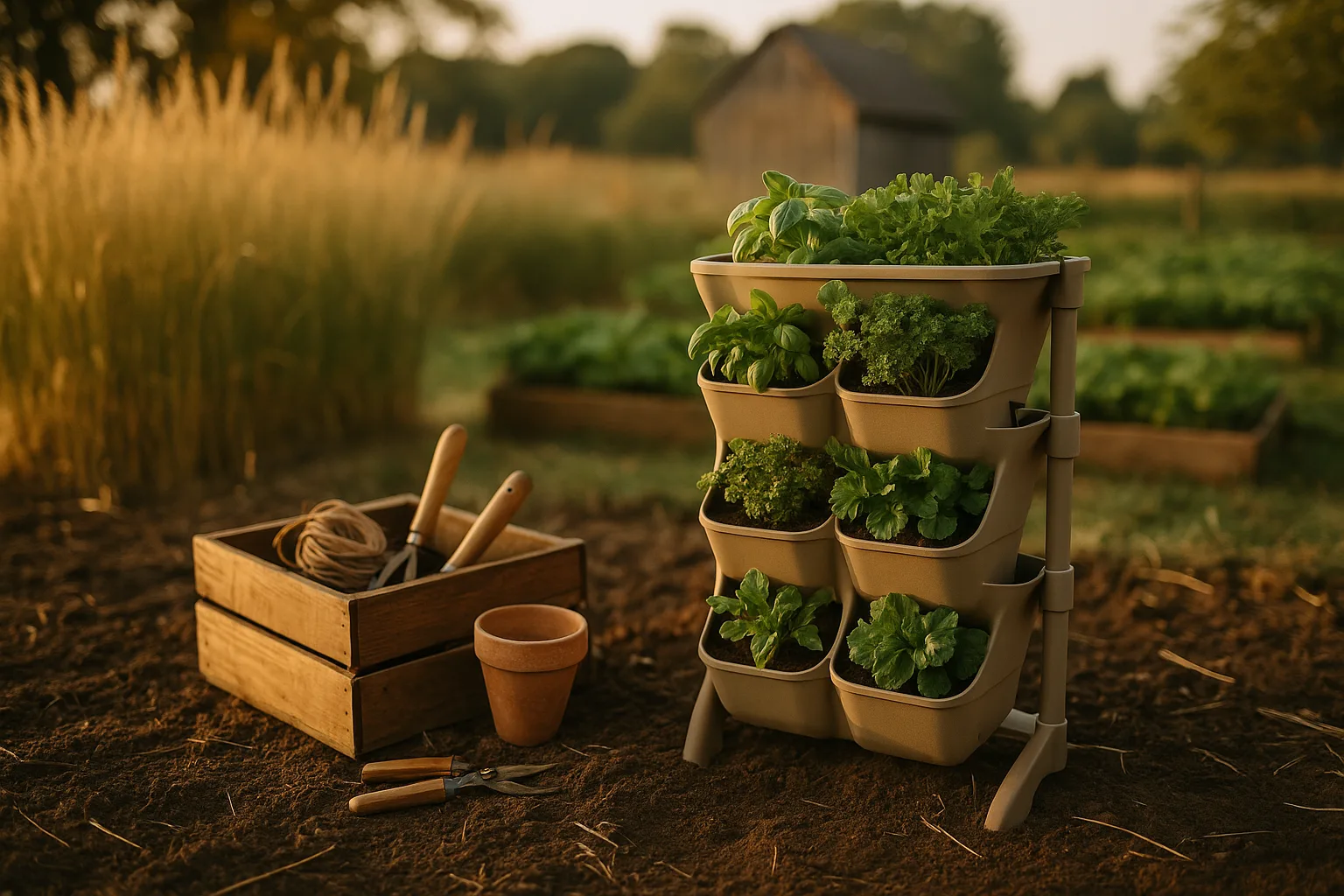
Choose the arrangement before selecting a brand. A wall-mounted pocket kit is not directly comparable to a large freestanding planter merely because both are called vertical gardens.
Measure usable space
Include the room needed to water, turn or service the system, harvest, and walk past it. Check mature plant spread and the proposed location’s light through the season. A tower against a wall may receive very different light on its two sides.
For a balcony, deck, roof, or wall installation, establish the permitted load and attachment method before purchasing. Filled containers, stored water, wet medium, plants, and the supporting structure all contribute. Obtain the appropriate building or property advice for the site.
Keep water from becoming a hidden problem
Confirm where drainage goes and how it is collected or discharged appropriately. Avoid a setup that wets walls, walkways, or the space below a balcony. Check the top, middle, and bottom growing sites rather than assuming a single watering point serves every root zone.
The University of Maryland container-growing guide explains container media, drainage, and nutrient considerations. Apply those principles with the exact kit’s instructions.
Compare the complete purchase
Check the current model’s dimensions, planting volume, included watering components, assembly, and replacement parts. For a hydroponic system, verify the pump, reservoir, light requirements, and nutrient instructions. An app feature does not establish that water or nutrient levels are automatically corrected.
Avoid filling every pocket with a large crop simply because a photo shows a full tower. Start with suitable plants at workable spacing and expand only when the arrangement is manageable.
For indoor growing, compare the hydroponic herb checklist and light-system guide before buying separate accessories.
A soil tower to compare with the layout
The Garden Tower 2 product page describes a rotating soil planter with a central composting tube and 50 planting positions. It is a freestanding soil system, not a wall-pocket kit or a powered hydroponic tower. Check its filled load, access around the base, and the light available to each side.
Check the Garden Tower 2 at Garden Tower Project through our affiliate link. Compare the selected color and included parts, and treat casters and other accessories as separate unless the actual bundle includes them. Choose crops and spacing for their mature size instead of treating the position count as a harvest promise.
Calculating Structural Dead Load and Saturated Potting Media Mass
Every vertical growing arrangement concentrates weight into a narrow footprint. Before placing any freestanding soil tower, stacked planter column, or water-filled hydroponic tower on an elevated deck, apartment balcony, rooftop patio, or porch overhang, calculate the total saturated weight of the assembly and compare it against the building’s verified structural load rating.
Dry potting mix is deceptively light in the bag, often weighing 15 to 25 pounds per cubic foot when loose and dry. Once thoroughly irrigated to field capacity, container media holds a substantial volume of water inside its pore spaces. According to structural and container-horticulture guidelines from the University of Maryland Extension container vegetable guide and North Carolina State Extension container gardening resources, saturated peat-lite or bark-based potting media commonly weighs 35 to 55 pounds per cubic foot, and media blended with mineral topsoil, sand, or dense finished compost can exceed 65 to 75 pounds per cubic foot. Water itself weighs 8.34 pounds per gallon (62.4 pounds per cubic foot).
| Vertical System Configuration | Approximate Media or Water Volume | Estimated Empty Hardware Mass | Estimated Saturated Media / Water Mass | Estimated Mature Plant + Moisture Load | Total Estimated Operating Weight | Footprint Concentration Notes |
|---|---|---|---|---|---|---|
| Large Freestanding Composting Soil Tower (e.g., 6 to 7 cu ft capacity) | 6.0 to 7.0 cu ft potting mix + central compost core | 35 to 45 lbs | 240 to 385 lbs | 25 to 45 lbs | 300 to 475+ lbs | Concentrates 300–475 lbs onto a ~4 sq ft base (~75–120 lbs/sq ft point load) |
| 5-Tier Stacked Modular Pocket Planter (Small Herb Column) | 1.5 to 2.5 cu ft potting mix | 8 to 15 lbs | 55 to 135 lbs | 10 to 20 lbs | 73 to 170 lbs | Narrow footprint; top-heavy in wind unless anchored or weighted at base |
| Wall-Mounted Felt or Rigid Pocket Panel (12-Pocket Module) | 0.75 to 1.5 cu ft potting mix | 4 to 12 lbs | 30 to 80 lbs | 8 to 15 lbs | 42 to 107 lbs | Shear and pullout forces act directly on wall fasteners and sheathing |
| 20-Gallon Container with 6-Foot Vertical Trellis Frame | 2.5 to 3.0 cu ft potting mix | 10 to 25 lbs | 90 to 165 lbs | 20 to 40 lbs | 120 to 230 lbs | High wind-sail area on trellis requires rigid stabilization |
| Recirculating Vertical Hydroponic Tower (20 to 30 Gallon Base) | 20 to 30 gal nutrient solution | 20 to 35 lbs | 167 to 250 lbs | 15 to 35 lbs | 202 to 320 lbs | Concentrated over reservoir footprint; requires GFCI electrical outlet nearby |
Building codes for residential balconies and decks typically specify a uniform live load rating (often 40 to 60 pounds per square foot when constructed to modern standards, though older or weathered structures may have lower safe margins), and point loads near the center of a span behave differently from loads positioned directly over a structural beam or load-bearing wall. Always verify the permitted load with a licensed structural engineer, building inspector, or property manager before installing heavy vertical planters above ground level.
Root-Zone Volume and Crop Allocation by Tier
A vertical planter with 30, 40, or 50 planting apertures does not provide 50 independent 5-gallon root zones. Instead, plants share a common column of soil or occupy individual shallow pockets. Matching crop root architecture and canopy habit to the physical tier of the planter prevents overcrowding, root competition, and shading of lower tiers.
   +-------------------------------------------------------+
   | TOP TIER / CROWN (Highest Direct Light & Airflow)     |
   | Best for: Bush dwarf tomatoes, compact peppers,       |
   |           eggplant, bush basil, or rosemary           |
   +-------------------------------------------------------+
   | UPPER-MIDDLE TIERS (Strong Lateral Light, Warm Zone)  |
   | Best for: Cut-and-come-again leaf lettuce, swiss      |
   |           chard, bush beans, strawberries, parsley    |
   +-------------------------------------------------------+
   | LOWER-MIDDLE TIERS (Filtered Light, Moderated Temp)   |
   | Best for: Spinach, arugula, bok choy, cilantro,       |
   |           chives, green onions,thyme, oregano         |
   +-------------------------------------------------------+
   | BOTTOM TIER (Highest Moisture Retention, Trailing)    |
   | Best for: Trailing nasturtiums, vining cucumbers or   |
   |           dwarf winter squash trained outward         |
   +-------------------------------------------------------+
Selecting Potting Media for Vertical Columns
Never fill a vertical tower or stacked container system with native garden soil or heavy clay topsoil. Native soil loses its aggregation when confined in a tall column, compacting under repeated overhead watering until drainage stalls and root zones become hypoxic (oxygen-starved).
Extension horticulturists at Clemson Cooperative Extension (HGIC 1251: Container Vegetable Gardening) recommend a porous, soilless container substrate formulated from:
- Coarse sphagnum peat moss or buffered coconut coir (50% to 60% by volume) for capillary moisture retention without excessive bulk density.
- Horticultural perlite or coarse pine bark fines (25% to 35% by volume) to maintain permanent air-filled porosity (macropores) even when the column is fully irrigated.
- Screened finished compost or worm castings (10% to 15% by volume) for cation exchange capacity and baseline micronutrients.
In a deep freestanding column, perlite helps resist gravitational settling over a multi-month growing season. When refreshing a vertical soil column between seasons, inspect the lower third of the cylinder for compaction and blend fresh coarse perlite or pine bark fines back into the profile before replanting.
Hydraulic Distribution and Vertical Moisture Gradients
Gravity pulls irrigation water downward through any vertical planter. In stacked tier planters and tall soil towers, this creates a pronounced vertical moisture gradient:
- Top tiers drain rapidly and experience higher evaporative demand from wind and direct sun.
- Middle tiers remain moderate if water percolates evenly, or develop dry channels if water bypasses hydrophobic peat pockets.
- Bottom tiers accumulate percolating water and remain near saturation longer after each watering cycle.
| Vertical Arrangement | Typical Hydraulic Failure Mode | Corrective Watering and Drainage Practice |
|---|---|---|
| Freestanding Deep Soil Column | Water channels down the outer wall or center core, leaving lateral pockets dry | Irrigate slowly in two stages (wetting pass followed by a deep soak 10 minutes later); verify moisture 3 inches inside middle and upper pockets |
| Stacked Tiered Planters | Top tier overflows before water percolates through the center drain to lower trays | Water the top tier gradually and supplement middle/lower tiers directly at the lip if cascade ports clog with roots |
| Wall-Mounted Felt Pockets | Rapid evaporative drying from wind exposure; water drips down backing wall | Install an impermeable waterproof backing board with an air gap and bottom gutter; use micro-drip emitter line on each row |
| Recirculating Hydroponic Tower | Pump screen blockage or power outage stops trickle over suspended bare roots | Clean pump intake pre-filter every 7–14 days; keep backup circulation pump on hand; shelter reservoir from direct midday solar heating |
When growing in wall-mounted pockets or stacked tiers on a balcony, always provide secondary containment—such as a heavy-duty catch basin, drip tray, or diverted drainage trough—so nutrient-tinted leachate never stains siding, rots wood decking, or drips onto neighbors below.
Sun Orientation, Rotation, and Microclimate Management
Unlike a horizontal raised bed where the sun passes directly overhead across every square foot of soil, a vertical cylinder or wall unit intercepts sunlight primarily at an oblique angle. A tower placed against a south-facing masonry wall receives intense direct radiation and reflected radiant heat on its front hemisphere, while its rear hemisphere faces permanent shade.
- Rotating freestanding towers: If a soil tower includes a rotating bearing base, rotate the cylinder 90 to 180 degrees every 2 to 3 days so all planting faces receive balanced Photosynthetically Active Radiation (PAR). Before purchasing a rotating model, confirm that you have at least 24 to 30 inches of clear walkway access around the perimeter to turn the loaded column safely and reach every pocket.
- Fixed wall units and non-rotating stacks: Place shade-tolerant leafy greens (spinach, looseleaf lettuce, cilantro, mint, parsley) on east-, north-, or lower shaded faces, and reserve the sunniest south- or west-facing upper pockets for fruiting crops or Mediterranean herbs that require 6 to 8+ hours of direct sun.
- Thermal buffering: Small-volume pockets on dark plastic or felt wall panels heat up rapidly during summer afternoons, pushing root-zone temperatures above 90°F (32°C), which stalls root respiration and triggers premature bolting in cool-season greens. Light-colored containers, shading of the container wall by trailing foliage, and morning irrigation help moderate root-zone temperature spikes.
Pre-Purchase Site and Hardware Verification Checklist
Before ordering a vertical garden kit, work through this six-point verification checklist:
- Structural and Surface Clearance: Measure the exact footprint width, total assembled height, and required service perimeter. Verify the balcony, deck, or wall fastener load capacity against the fully saturated weight from the table above.
- Solar Exposure Audit: Observe the installation spot at 9:00 AM, 12:00 PM, 3:00 PM, and 6:00 PM. Count the hours of direct, unfiltered sunlight on each side of the planned structure.
- Water Supply and Runoff Capture: Identify the nearest hose bibb or water source, choose how you will apply water without splashing walls, and verify how excess drainage water will be captured or routed safely.
- Media Volume Calculation: Calculate the cubic feet (or quarts) of soilless potting mix required to fill the unit completely, plus 15% extra to account for initial settling after the first two thorough waterings.
- Winterization Plan: Determine whether the plastic, resin, felt, or pump hardware is rated to remain outdoors during freezing temperatures in your USDA Hardiness Zone, or whether the unit must be emptied, cleaned, and stored under cover before hard freezes expand wet media.
- Pocket-by-Pocket Planting Map: Assign specific varieties to only 60% to 75% of the available pockets on your first planting cycle, leaving strategic gaps around vigorous growers (such as zucchini, bush tomatoes, or strawberries) so mature foliage has room to breathe and dry after rain or irrigation.
Products in this guide
Garden Tower 2 50-Plant Composting Vertical Garden Planter
Manufacturer-listed 50-plant vertical container system with central vermicomposting tube and rotating base. Check current footprint and soil volume requirements at the retailer.
View product at retailer →Check current specifications, price and availability at the retailer.
Grant & Fiona walk through this garden question. Subscribe for the next practical garden explanation.
Subscribe on YouTube