Plants That Attract Bees & Hummingbirds
Choose double-duty flowering plants that feed both bees and hummingbirds from spring through fall, including bee balm, salvia, and red columbine.
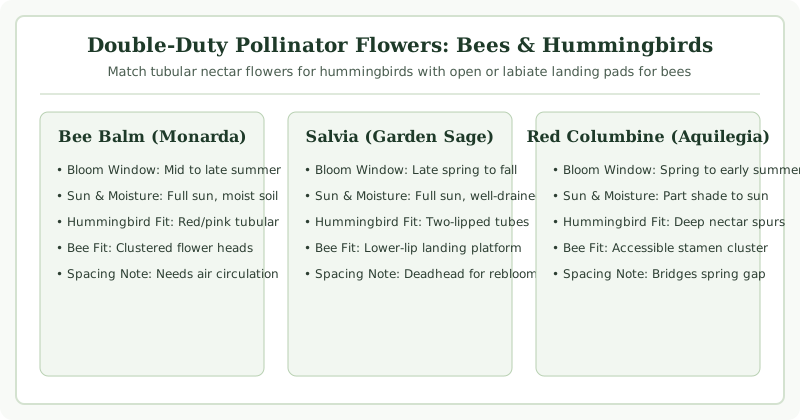
To attract both bees and hummingbirds in the same garden bed, plant species that combine nectar-rich tubular florets with accessible landing lips or exposed stamens—specifically red columbine (Aquilegia canadensis) for spring, bee balm (Monarda) and garden sage (Salvia) for summer, and anise hyssop (Agastache) or annual salvias into early autumn.
Most pollinator lists split plants into two separate camps: flat, open daisies for short-tongued bees, and deep, narrow red trumpets exclusively for hummingbirds. When space is limited in a raised bed border or container corridor, planting separate single-guild flowers wastes square footage. By choosing double-duty flowering plants whose floral geometry serves both long-billed hovering birds and foraging bees, you can support pollination around fruiting crops like tomatoes, squash, peppers, and pole beans from April through frost.
Why Floral Geometry Determines Who Can Feed
Penn State Extension’s pollinator garden guidance explains that different pollinator groups filter flowers by color spectrum, nectar sugar concentration, and corolla depth:
- Hummingbirds see strongly in the red-to-orange spectrum, have little sense of smell, and feed while hovering. They favor pendulous or horizontal tubular blossoms that hold abundant, dilute sucrose nectar protected from rain.
- Bumblebees and native solitary bees see ultraviolet, blue, and purple wavelengths, use scent cues, and require a physical petal lip or flower head to land on while probing for nectar and collecting protein-rich pollen.
Flowers in the mint family (Lamiaceae)—including bee balm (Monarda), salvias (Salvia), anise hyssop (Agastache), and catmint (Nepeta)—bridge both requirements. Each flower spike holds dozens of individual two-lipped (bilabiate) tubes: the lower lip acts as a landing pad for bees, while the nectar reservoir at the base of the tube feeds hummingbirds and long-tongued bumblebees alike.
Top Double-Duty Plants Ranked by Bloom Window
| Plant Name | Primary Bloom Season | Flower Color & Form | Sun & Soil Requirement | Primary Garden Role |
|---|---|---|---|---|
| Eastern Red Columbine (Aquilegia canadensis) | Mid-spring to early summer | Red-and-yellow nodding spurs with protruding yellow stamens | Part shade to full sun; well-drained woodland or border soil | Feeds spring migrant hummingbirds and queen bumblebees |
| Woodland / Meadow Sage (Salvia nemorosa) | Late spring through summer (with deadheading) | Violet-blue spikes of two-lipped tubular flowers | Full sun; average, well-drained soil | Compact border perennial for raised bed corners |
| Scarlet Bee Balm (Monarda didyma) | Mid to late summer | Red, pink, or purple whorled tubular heads | Full sun to light shade; moist, rich soil | High-nectar summer magnet near fruiting vegetables |
| Wild Bergamot (Monarda fistulosa) | Mid to late summer | Lavender-pink clustered tubular heads | Full sun; tolerates drier soil than M. didyma | Drought-tolerant native bee and hummingbird anchor |
| Anise Hyssop (Agastache foeniculum) | Midsummer to frost | Purple bottle-brush spikes of small tubes | Full sun; well-drained loam | Late-season nectar and pollen bridge |
| Scarlet Runner Bean (Phaseolus coccineus) | Summer to early fall | Bright red papilionaceous clusters | Full sun; fertile soil with a tall trellis | Edible vertical screen that feeds hummingbirds and bumblebees |
1. Spring Bridge: Eastern Red Columbine (Aquilegia canadensis)
One of the most common mistakes in vegetable garden pollinator borders is waiting until July for flowers to open. Overwintered queen bumblebees emerge in early spring when nightshades and cucurbits are not yet blooming, and ruby-throated hummingbirds arrive on spring migration looking for early high-energy nectar.
University of Maryland Extension’s pollinator profile on Eastern red columbine notes that Aquilegia canadensis blooms from April into June across much of eastern North America. Its nodding red-and-yellow blossoms feature five upward-pointing nectar spurs:
- For hummingbirds: The long red spurs hold nectar matched to a hummingbird’s bill and tongue.
- For native bees: The downward-hanging cluster of bright yellow stamens provides abundant, exposed pollen that bumblebees and solitary mason bees gather by clinging directly to the filaments.
Because red columbine tolerates partial shade and cool spring soil, it fits the north or east edge of a raised bed layout where taller summer crops would otherwise cast shade later in the season.
2. Early-to-Mid Summer Anchor: Salvia nemorosa and Perennial Sages
As columbine finishes blooming in June, perennial salvias take over. University of Minnesota Extension’s pollinator plant recommendations highlight salvias for their dense vertical flower spikes and reliable reblooming habit when spent stems are sheared back after the first flush.
- Why bees work it: Violet-blue and purple-stemmed cultivars like Salvia nemorosa ‘Caradonna’ sit squarely in the visual spectrum bees locate fastest from a distance. The sturdy lower petal lip supports heavy bumblebees as well as smaller leafcutter and sweat bees.
- Why hummingbirds visit: Despite being purple rather than red, the tubular florets recharge nectar quickly in warm weather, drawing hummingbirds along bed edges.
- Placement tip: Perennial salvias prefer well-drained soil and moderate moisture, making them ideal companions alongside Mediterranean herbs or around the drier perimeter of raised garden bed layout plans.
3. Peak Summer Powerhouse: Bee Balm (Monarda didyma and Monarda fistulosa)
During July and August—when tomatoes, zucchini, cucumbers, and melons require peak pollination—few plants match Monarda. Oregon State University Extension and eastern land-grant programs consistently rank Monarda among the highest-value dual-guild nectar plants.
Choosing Between Monarda didyma and Monarda fistulosa
- Scarlet Bee Balm (Monarda didyma): Produces vivid crimson-red flower whorls that hummingbirds spot from across a yard. It performs best in consistently moist, organic-rich soil (similar to irrigated vegetable beds). Because its deep corollas are long, hummingbirds, hawk moths, and long-tongued bumblebees are its primary nectar visitors, while smaller bees forage pollen at the anthers.
- Wild Bergamot (Monarda fistulosa): Bears lavender-pink flowers with slightly shorter floral tubes, allowing a wider diversity of medium- and short-tongued native bees to reach nectar alongside hummingbirds. It also tolerates drier summer soil than M. didyma.
Managing spread and airflow: Bee balm spreads by shallow rhizomes in loose raised-bed soil and can develop powdery mildew if crowded against dense tomato foliage. Give clumps 18 to 24 inches of breathing room, or plant them in dedicated corner pots where root spread stays contained and air moves freely through the stems.
4. Late Summer to Frost: Anise Hyssop (Agastache) and Fuchsia / Annual Salvias
By late August, many perennial borders fade just as migrating hummingbirds need fuel for their southward journey and bumblebee colonies are rearing next year’s queens.
- Anise Hyssop (Agastache foeniculum): Produces fragrant purple flower spikes packed with hundreds of tiny tubular florets that bloom continuously from midsummer until hard frost. Bees work the spikes all day without crowding out hovering hummingbirds.
- Container Fuchsia and Salvia guaranitica (Black and Blue Sage): In patio containers or hanging baskets near a container gardening setup, trailing fuchsia and deep-blue Salvia guaranitica provide pendulous nectar tubes at eye level through October. Always choose single-flowered fuchsia varieties rather than tightly doubled cultivars, which block access to the nectary and stamens.
Designing a Small-Space Pollinator Corridor
Rather than scattering single plants across the yard, group 3 to 5 stems of the same flowering species into a visible drift at the ends of vegetable beds:
- Clump by bloom period: Pair one spring species (red columbine), two summer anchors (perennial salvia and bee balm), and one late-season bloomer (anise hyssop or annual salvia) so at least two species overlap every month.
- Keep heights tiered: Place low 12–18 inch salvias on the sunny south edge of the bed and 3-foot bee balm or trellised scarlet runner beans on the north end so flowers never shade vegetable seedlings.
- Avoid systemic insecticides and bloom-time sprays: Even organic contact sprays applied to open blossoms can harm foraging bees; read our guide on plants that attract beneficial insects for habitat-first pest management.
Comparing Pollinator Seed & Starter Options
When buying seed packets or starter plants for a pollinator border, verify the exact botanical name on the label rather than relying on generic front-of-packet photos. You can search Amazon for bee balm (Monarda) seeds, search Amazon for Salvia nemorosa ‘Caradonna’ garden sage, or browse hummingbird and butterfly wildflower seed mixes on Amazon. With any mixed wildflower packet, check the species list against your state extension’s native and non-invasive plant guide before broadcasting seed near vegetable beds.
Products in this guide
Bee Balm (Monarda) Seeds
Amazon search for bee balm (Monarda) seeds. Compare species (Monarda didyma vs. Monarda fistulosa), mature height, and mildew-resistant cultivar notes before ordering.
Find matching listings on Amazon →Search results may include other models. Check the model and size before buying.
Salvia nemorosa Caradonna Pollinator Sage
Amazon search for Salvia nemorosa Caradonna. Check hardiness zone ratings, mature clump width, and seed versus live starter plant format before buying.
Find matching listings on Amazon →Search results may include other models. Check the model and size before buying.
Hummingbird and Butterfly Wildflower Seed Mix
Amazon search for hummingbird and butterfly wildflower seed mixes. Verify the exact species list on the packet to avoid invasive or non-adapted regional annuals.
Find matching listings on Amazon →Search results may include other models. Check the model and size before buying.