When to Transplant Bean Seedlings From Trays
Check frost risk, 60°F soil warmth, 2–3 week hardening off, and intact root modules before transplanting bean seedlings outdoors.
If you are deciding when to transplant bean seedlings started in trays or small pots, wait until all local danger of frost has passed, your garden soil has warmed to at least the 60°F (about 16°C) benchmark cited for common beans, and the young plants have completed about two to three weeks of gradual hardening off. For container-started French beans (Phaseolus vulgaris), the Royal Horticultural Society notes that seedlings raised in small pots or deep modules can move to their final positions once frost risk is over and plants are around 8cm (3 inches) tall. Because bean roots are shallow and easily disturbed, transplant each module intact rather than relying on a fixed calendar day count.
Why bean transplant timing depends on conditions, not a day count
Growers who switch from direct sowing in cool or pest-heavy beds to starting beans in trays often ask for a single transplant milestone. In practice, readiness depends on both plant development inside the module and outdoor conditions in the bed. A seedling raised in a warm, bright room reaches transplant size at a different pace than one started on a cool windowsill or in an unheated porch. Relying on a fixed number of days after sowing can put tender plants into cold ground too early or leave vigorous seedlings tangling inside cells for too long.
According to the Royal Horticultural Society guide to growing French beans, common French beans (Phaseolus vulgaris) can be sown indoors in small pots or deep modules at one seed per cell, then planted outdoors after all danger of frost has passed. In its section on small outdoor pots, the Royal Horticultural Society specifies moving young plants to their final growing positions once frost danger has passed and the plants reach around 8cm (3 inches) tall. That 8cm (3-inch) figure provides a clear plant-size reference from a documented horticultural source while keeping frost clearance as the non-negotiable outdoor gate.
Extension guidance explains why beans need careful timing in the first place. University of Minnesota Extension notes that beans have shallow root systems that are easily damaged by disturbance or cultivation, and that cool weather slows plant growth while cold soil can rot seed. The UC Statewide IPM Program cultural tips for growing beans likewise state that common snap beans are best direct-sown once soil temperature reaches 60°F or higher (about 16°C) and frost danger has passed. When trays are used to bridge cool early-season conditions, the transplant window opens only when the seedling holds together in an uncrowded root plug and the outdoor bed meets those warmth and frost-free requirements.
Six checks before transplanting bean seedlings outdoors
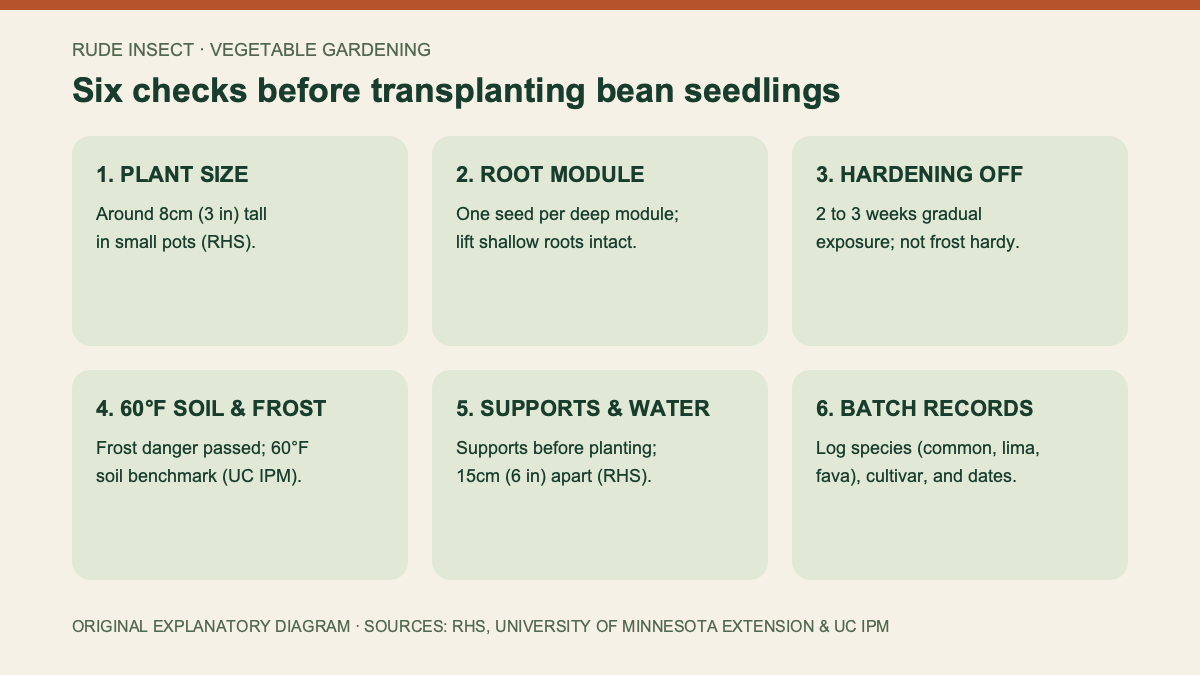
Before moving tray-grown bean seedlings into open ground or raised beds, evaluate six distinct checks: seedling size, root-module integrity, hardening-off status, soil temperature and frost clearance, bed and support preparation, and batch records. Treating these as separate gates prevents a sunny afternoon or a tall stem from masking cold soil or unacclimated leaves.
| Check | What to verify before planting out | Primary source basis |
|---|---|---|
| Seedling size | Plants around 8cm (3 in) tall, sturdy and not tangled with neighbors | Royal Horticultural Society (French beans) |
| Root module | Individual pot or deep module lifts intact without tearing shallow roots | Royal Horticultural Society; University of Minnesota Extension |
| Hardening off | Gradual outdoor exposure completed over about 2 to 3 weeks | Royal Horticultural Society (hardening off tender plants) |
| Soil and frost | All local frost danger past; soil at or above 60°F (~16°C) for common beans (70°F for lima beans) | UC Statewide IPM Program; University of Minnesota Extension |
| Supports and spacing | Poles or supports installed prior to planting; 15cm (6 in) spacing ready; watered before and after | Royal Horticultural Society; University of Minnesota Extension |
| Crop and seed record | Species (Phaseolus vulgaris vs. lima or fava), cultivar, and seed lot recorded | University of Minnesota Extension; UC Statewide IPM Program |
1. Seedling size: around 8cm (3 inches) tall
In the Royal Horticultural Society French beans guide, young plants raised in small pots are moved to their final positions once they are around 8cm (3 inches) tall and all danger of frost has passed. At this stage, a healthy bean seedling lifts cleanly from its cell without toppling or twining around neighbors.
Waiting until stems stretch far beyond their modules creates handling risks as shoots twist together across the tray. Conversely, turning out a cell before roots occupy the mix allows compost to crumble away, exposing bare roots. Use the 8cm (3-inch) benchmark alongside a check that the module holds together as one unit.
2. Root-module integrity: one seed per deep module or small pot
University of Minnesota Extension points out that bean plants have shallow roots sensitive to disturbance. Starting beans in open flats where seedlings must be pried apart works against the crop by breaking fine root hairs.
To avoid root tearing, the Royal Horticultural Society recommends sowing one seed per small pot or deep module. Water the trays beforehand so the root ball stays cohesive, ease the plug out gently, and set the intact module directly into its prepared planting hole.
3. Hardening off: two to three weeks of gradual acclimation
Moving indoor-started bean seedlings straight from a tray to full outdoor sun and wind shocks the foliage, even above freezing. Both the Royal Horticultural Society French beans guide and the Royal Horticultural Society guide to hardening off tender plants state that indoor-raised plants should be hardened off before planting outdoors.
According to the Royal Horticultural Society hardening-off guidance, hardening off takes about two to three weeks of gradual exposure to outdoor conditions:
- Start in daytime shelter: When trays are not in a cold frame or greenhouse, place plants outdoors in a lightly shaded, sheltered spot for a few hours during the mildest part of the day, then bring them indoors before evening cools.
- Increase sun and breeze gradually: Over two to three weeks, lengthen daily outdoor exposure and introduce brighter light and normal garden breeze.
- Keep night protection: Bring tender bean trays indoors at night—or cover them in a frost-free structure—until frost risk ends.
- Remember what hardening off cannot do: As the Royal Horticultural Society explicitly notes, hardening off acclimates plants to outdoor conditions, but it does not make tender plants frost hardy. A hardened-off French bean will still suffer injury in freezing temperatures.
4. Soil warmth and frost clearance: the 60°F benchmark
Air temperature on a sunny afternoon can feel mild while soil several inches down remains cold and wet. Both University of Minnesota Extension and the UC Statewide IPM Program stress waiting until frost danger has passed and soil has warmed.
Specifically, the UC Statewide IPM Program states that common snap beans (Phaseolus vulgaris) are best sown once soil temperature reaches 60°F or higher (about 16°C) and frost danger is past, while lima beans prefer warmer soil at 70°F. Although UC’s guide describes direct sowing as the standard benchmark, that 60°F soil-temperature figure is equally useful when checking whether a garden bed is warm enough for common bean transplants. Keep the distinction clear: 60°F is a soil-temperature benchmark for warm-season root activity, not an air-frost threshold.
University of Minnesota Extension explains that cold soil promotes rot and cool weather slows bean growth. Check your own soil with a thermometer at planting depth, verify that your local frost window has closed, and confirm good drainage before transplanting.
5. Regional calendars vs. local bed readiness
Published horticultural guides often include month-by-month examples to illustrate seasonal flow in their own regions. The Royal Horticultural Society French beans guide references sowing indoors in April or May and planting out in May or June in the United Kingdom, while University of Minnesota Extension references Minnesota spring timing around local last-frost dates.
Treat those months as regional examples attached to their respective institutions, not as universal calendar rules. Anchor your transplant date to your own local frost-free window and your own measured soil temperature rather than copying a calendar month from another climate zone.
Preparing the bed and planting out without disturbing shallow roots
Once your seedlings are around 8cm (3 inches) tall in intact modules, hardened off over two to three weeks, and your bed is frost-free with soil at 60°F or warmer, the planting step should protect the root ball at every stage.
Install supports before a single seedling goes into the soil
If you are growing climbing French beans or pole beans, the Royal Horticultural Society advises preparing and erecting supports before planting. Driving canes, stakes, or trellis posts into the soil after seedlings are already in place risks piercing or compacting the shallow root zone that University of Minnesota Extension warns is easily damaged.
Water before and after planting, and space at 15cm (6 inches)
The Royal Horticultural Society French beans guide gives a clear sequence for young container-raised plants:
- Choose a warm, sunny, well-drained site: Both the Royal Horticultural Society and University of Minnesota Extension emphasize good drainage and warmth.
- Water seedlings before planting: Moistening the pots or deep modules ahead of time keeps the potting medium bound around the roots as you slide each plug out.
- Space plants 15cm (6 inches) apart: When setting French bean transplants into their final positions, the Royal Horticultural Society specifies spacing plants 15cm (6 inches) apart.
- Water well after planting: Settling the soil with water immediately after transplanting bridges moisture between the module and garden soil. Keep later weeding and cultivation shallow so surface roots are not sliced.
Why bean species and seed records matter before you transplant
Not every crop called a “bean” shares the same temperature threshold. Checking the species on the packet prevents applying common snap bean rules to a crop with different thermal needs:
- Common beans (Phaseolus vulgaris): Warm-season, frost-tender bush and pole beans. Use the UC Statewide IPM Program 60°F (16°C) soil-temperature benchmark, the Royal Horticultural Society ~8cm (3-inch) transplant size in deep modules or small pots, and post-frost timing.
- Lima beans (Phaseolus lunatus): Warm-season and frost-tender, but the UC Statewide IPM Program notes that lima beans prefer warmer 70°F soil.
- Fava or broad beans (Vicia faba): University of Minnesota Extension distinguishes fava beans as a cool-season crop rather than a warm-season Phaseolus bean.
Label each tray and bed entry with the crop species, cultivar name, sowing date, module depth, hardening-off start date, and transplant date. If you plan to save seed later in the season, record whether the seed lot is open-pollinated or hybrid; see the open-pollinated vs. hybrid seeds guide for how parent seed type affects future seed saving.
When direct sowing is still the simpler choice
Both University of Minnesota Extension and the UC Statewide IPM Program present direct sowing into warm, frost-free garden soil as the standard way to grow common beans. Once outdoor soil has reached 60°F or higher and frost risk is over, direct-sown beans germinate quickly without any container transition. Starting in small pots or deep modules, as described by the Royal Horticultural Society, is primarily useful when bridging cool early weeks before your local frost-free date.
Frequently Asked Questions
At what size should bean seedlings be transplanted from trays or small pots?
According to the Royal Horticultural Society’s guide to growing French beans, young plants started in small pots or deep modules can be moved to their final outdoor positions once they are around 8cm (3 inches) tall and all danger of frost has passed, after being hardened off.
Should you transplant bean seedlings based on a fixed 10-to-14-day rule?
No single day count works across all indoor temperatures and lighting setups. Instead of relying on calendar days alone, check that the seedling is around 8cm (3 inches) tall with an intact root plug in its individual module, that it has been hardened off for about two to three weeks, that local frost danger has passed, and that soil temperature has reached at least 60°F (about 16°C) for common beans.
Does hardening off make bean seedlings frost hardy?
No. The Royal Horticultural Society’s guidance on hardening off tender plants states that gradual outdoor exposure over about two to three weeks acclimates plants to outdoor sun, wind, and temperature fluctuations, but it does not make tender plants frost hardy.
Why do bean seedlings struggle if their roots are disturbed during transplanting?
University of Minnesota Extension notes that beans have shallow root systems that are easily damaged by disturbance or cultivation. Sowing one seed per small pot or deep module, watering before and after planting, and installing climbing supports before planting helps move the root ball intact.
What soil temperature do beans need before planting outdoors?
The UC Statewide IPM Program states that common snap beans (Phaseolus vulgaris) are best planted once soil reaches 60°F or higher (about 16°C) and frost danger has passed, while lima beans prefer warmer 70°F soil. Fava beans are a cool-season crop with different temperature tolerances than warm-season common beans.