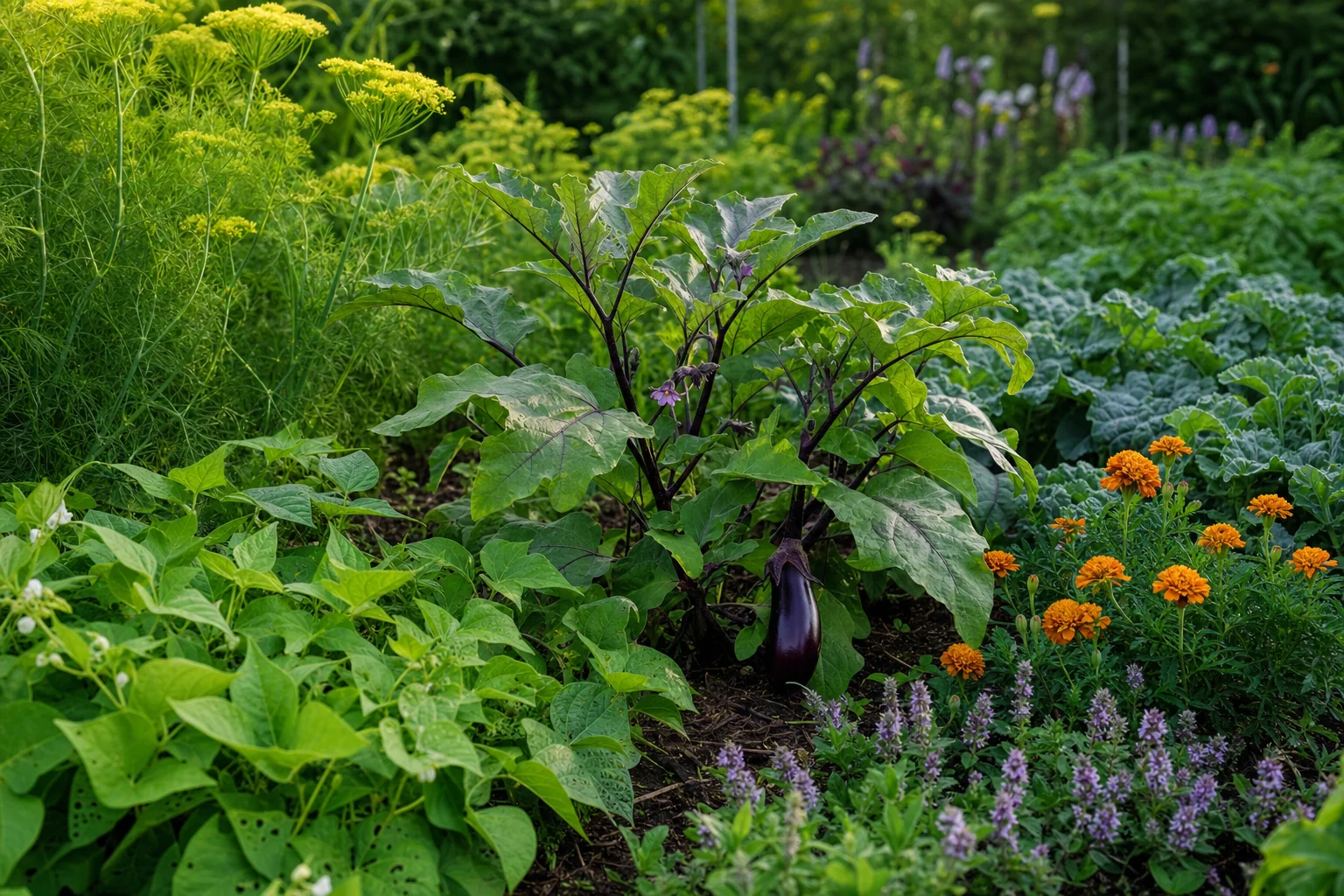
The Best Eggplant Companion Plants (Flea Beetle Defense That Held)
Eggplant's biggest enemy is the flea beetle, and these companions actually moved the needle — the beans that fed the soil, the marigold and catnip border that
Like this garden guide? Subscribe to Rude Insect on YouTube for more hands-on growing videos.
Subscribe on YouTube
Seven eggplant companion plants earned a spot in our beds after the flea beetles made Swiss cheese out of our first planting. Not “a few cute holes.” I mean leaves peppered so badly the plants stalled for three weeks, sat there sulking, then gave us two sad eggplants in August. This was in our Zone 6b kitchen garden, where eggplant already has to hustle before nights cool down. The companions that actually moved the needle here were boring in the best way: bush beans nearby, basil tucked close, marigolds and catnip on the edge, and fennel kept far away like it owed somebody money.
We still use row cover early. I’m not going to pretend companion planting is a force field. Flea beetles laugh at optimism. But after a few seasons of testing combinations — and ripping out a few bad ideas — I’m convinced eggplant does better when it’s not sitting alone in bare soil with a neon sign that says “free buffet.”
If you’re starting fresh, I’d grab a simple Eggplant Seeds Starter Pack and grow more plants than you think you need. Eggplant seedlings are dramatic. Some stall. Some get chewed. A few become the glossy, ridiculous overachievers that make the whole bed worth it.
Eggplant companion plants that helped us keep flea beetles from taking over
Flea beetles are tiny, jumpy, and rude. They show up right when young eggplants are tender, usually after the first stretch of warm weather. Here, that’s late May into June. They prefer stressed plants, dry soil, and exposed beds. Which, unfortunately, describes a lot of beginner eggplant setups.
The biggest shift for us wasn’t one magic plant. It was a layered planting.
- Beans close enough to share the bed, but not smother.
- Basil between eggplants once the soil warmed.
- Marigolds and catnip along the border.
- Mulch after the soil had heat in it.
- Row cover until flowering, if flea beetles were already active.
That combination held better than eggplant alone. Not perfect. Better.
And better matters with eggplant. A plant that loses its first month to flea beetle damage may survive, but it often stays behind all season. You’ll water it. Feed it. Stare at it. Threaten it gently. Still behind.
If you’re planning the whole garden layout, this is where a broader companion planting guide helps, because eggplant doesn’t live in a vacuum. Its neighbors affect pests, airflow, watering, and how annoying the bed is to harvest.
Beans: the quiet helper I almost ignored
Bush beans don’t look like pest control. They look like beans. That’s partly why I like them.
We’ve grown Provider, Contender, and Royal Burgundy near eggplant. Provider has been the most reliable here, though Royal Burgundy is easier to spot when picking because the pods are purple. The beans didn’t stop flea beetles directly, at least not that I could prove. What they did was fill space, shade soil, and keep the bed from being a hot, dusty runway.
Eggplant likes steady moisture. Flea beetles seem worse when the plants are stressed. Beans help the bed behave.
I plant bush beans about 10 to 12 inches away from the eggplant stem, usually on the south or side edge where they won’t shade the eggplant too badly. If the bed is narrow — ours are mostly 30 inches wide — I’ll do eggplant down the center, beans offset along one side, basil in the gaps, and flowers near the corners.
Pole beans? We tried them once in the same bed.
Mistake.
They climbed the trellis, shaded the eggplants by mid-July, and turned harvest into a wrestling match. The eggplants grew, but they leaned hard toward the light and set fewer fruit. Pole beans belong nearby, not right on top of eggplant unless you’ve got a very intentional layout and full sun for days.
Bush beans are easier. Less bossy.
How close should beans be to eggplant?
Close enough to share the soil space, not so close that you’re snapping bean stems every time you harvest eggplant. I like 10 to 18 inches.
If your soil is tired, beans are a nice crop to rotate through that bed before or after eggplant, too. They’re legumes, though don’t expect miracles from one season. I’ve seen people talk like beans instantly “fix” a bed. Eh. They help. They don’t replace compost.
We still add compost every spring — about 1 inch across the bed — and I’ll sometimes scratch in a slow organic fertilizer if the eggplant leaves look pale. Eggplant is hungrier than beans.
Basil near eggplant: useful, tidy, and worth the seed packet
Basil is one of my favorite eggplant companion plants because it behaves itself. That counts for a lot.
It stays compact if you pinch it. It likes similar warm conditions. It doesn’t make harvesting miserable. And when you brush past it, the whole bed smells like dinner.
Did basil single-handedly defeat flea beetles? No. I wouldn’t claim that. But basil did seem to help confuse the planting a bit, and it filled open soil around the eggplants once the row cover came off. We had fewer battered leaves in the basil-mixed bed than in the eggplant-only bed during our 2023 side-by-side. Same yard, same week of transplanting, same compost. Not a scientific trial. Just two beds and a notebook with dirty fingerprints on it.
I tuck basil 8 to 12 inches from eggplant, usually after nights are reliably above 50°F. Basil sulks in cold soil. Don’t rush it. We’ve done that plenty, and it just sits there looking betrayed.
If you’re buying seed, a basic Genovese type is fine. No need to get precious unless you want Thai basil or purple basil for the kitchen. Here’s the kind of search I’d use for Basil Seeds (Companion) — check the current price, because seed prices bounce around more than they should.
One caution: don’t let basil go fully woody and huge right against young eggplant. Keep pinching. Use the basil. Pesto is pest management if you squint.
Marigolds didn’t fix everything, but I won’t plant eggplant without them now
Marigolds are where people get weird.
Some gardeners talk about them like they repel every pest from here to the county line. They don’t. We’ve had aphids on marigolds, slugs under marigolds, and one year a rabbit ate them down to nubs like it had a personal grudge.
Still, marigolds earned their place.
French marigolds along the edge of the eggplant bed gave us a thicker, smellier, more insect-active border. That matters. Companion planting isn’t always “this plant repels that bug.” Sometimes it’s “this bed now has more tiny wasps, hoverflies, spiders, and general chaos, so pests don’t get an easy clean shot.”
We use French marigolds more than giant African types near vegetables. The smaller ones fit better. I plant them 8 to 10 inches apart along the bed edge, not jammed into the eggplant roots. Give them some room or they turn into a mildew-prone mess by late summer.
The orange and yellow ones worked fine. I haven’t noticed color making a huge difference. Maybe someone has a better trial on that. I’m just telling you what held in our beds.
The marigold mistake we made
Year one, I planted marigolds too late. Like, after the eggplants were already chewed.
That was mostly pointless.
By the time the marigolds flowered, the flea beetles had done the early damage. Now I start marigolds indoors around the same time as tomatoes, or I buy a cheap six-pack if spring gets away from me. They go in when the eggplants go in, or soon after.
Small plants are fine. Waiting until July is not.
Catnip: effective, slightly feral, and not for tiny beds
Catnip surprised me.
I planted it because I’d read enough scattered reports about catnip and flea beetles that I figured it was worth a corner. The first year, I put one plant at the end of an eggplant row. By August, the catnip looked like it was trying to annex the bed.
But the eggplants nearest that catnip had less flea beetle chewing than the ones at the opposite end. Again, not a lab trial. Just obvious enough that I noticed while watering.
The smell is strong, especially when you bump it with a hose. Flea beetles may dislike that. Or maybe the catnip brought in more beneficial insects. Or maybe that corner had slightly better moisture. Take this with a grain of salt. I’m not 100% sure why it helped.
What I am sure about: don’t plant catnip in the middle of a small vegetable bed unless you enjoy regret.
Put it in a buried pot, a corner, or a nearby perennial strip. Cut it back hard before it flops. And if you have neighborhood cats, good luck. We had one roll on a young catnip plant so aggressively it snapped the main stem. The plant recovered. The cat looked proud.
Catmint is a tidier option. Not identical, but easier to live with. I still prefer true catnip for the eggplant border, but I treat it like a semi-wild tool, not a polite little herb.
Nasturtiums worked as a trap crop — sort of
Nasturtiums are pretty, edible, and useful. They’re also aphid magnets in our garden.
That can be good or bad.
I’ve grown nasturtiums near eggplant to pull aphids away from the main crop, and they did that part well. Too well, maybe. In 2024, the nasturtiums became an aphid hotel by mid-June, and then the ants showed up to farm them. I cut the whole mess out and fed it to the chickens.
For flea beetles, nasturtiums didn’t help as much as marigold and catnip here. They did fill soil, bloom early, and attract pollinators. But if I only had room for one border plant near eggplant, I’d choose French marigold over nasturtium.
If you do use nasturtiums, plant them on the edge where you can remove them fast. Don’t weave them through the eggplants. That sounds charming until you’re trying to find a black eggplant under a jungle of round leaves and aphids.
The companions I keep close, and the ones I keep at arm’s length
Eggplant plays nicely with a lot of warm-season crops, but “plays nicely” doesn’t mean “best neighbor.”
Peppers are fine nearby. They like similar conditions. But they’re also in the nightshade family, so I don’t love packing peppers, tomatoes, and eggplant into the same bed year after year. Disease and pest pressure can build. We rotate as best we can, though with a small garden, rotation is always a little fake. Be honest about that.
Tomatoes can grow near eggplant, but they’re heavy feeders and space hogs. If you do it, support them well. A flopped tomato plant will shade eggplant and make the bed damp and miserable. We use cages and stakes for tomatoes and sometimes for eggplant too, especially heavy varieties like Black Beauty or Rosa Bianca. A basic Tomato Cage / Stake Set is worth checking — see current price — because unsupported eggplant branches can snap once fruit gets heavy after a rain.
I don’t always cage eggplant. For compact varieties, a single bamboo stake works. But when we grow big Italian types, I stake early. Not after the plant is leaning with three fruit on one side. Been there. Snapped the branch. Said words.
Good eggplant neighbors we’ve used
- Bush beans for soil cover and bed health.
- Basil for scent, harvest, and filling gaps.
- French marigolds for a strong border and beneficial insect activity.
- Catnip or catmint near the edge, not in the middle.
- Calendula in nearby beds for pollinators.
- Thyme on dry edges, if it won’t get buried.
- Peppers nearby, but rotate when possible.
Calendula deserves a quick mention. I like it near vegetable beds, not always inside them. It reseeds here if I let it, and the flowers bring in small beneficial insects. It didn’t seem to change flea beetle pressure much, but it made the garden livelier. That counts, just not enough to call it my top eggplant companion.
Fennel: plant it far away from eggplant
Fennel is beautiful. Bronze fennel especially. Pollinators love the umbels, swallowtail caterpillars use it, and the whole plant smells clean and sharp.
Don’t tuck it into your eggplant bed.
Fennel has a reputation for suppressing nearby plants, and while gardeners argue about how dramatic that effect really is, I’ve seen enough poor growth around fennel that I don’t risk it with hungry crops like eggplant. We keep fennel in a separate herb/perennial area, several beds away from vegetables. At least 10 feet if I can manage it. More is better.
One year I let a fennel seedling stay at the end of a pepper and eggplant bed because it looked nice. The fennel thrived. The pepper beside it did not. Was fennel the only reason? Maybe not. That corner also dried out faster. But I pulled the fennel, watered deeply, and the pepper improved. That was enough for me.
Fennel is not evil. It just wants its own room.
Spacing matters more than people want to admit
You can choose the right eggplant companion plants and still make a mess if you cram everything too tightly.
Eggplant needs airflow. Flea beetle damage is the early headache, but later you can get fungal issues, aphids, mites, and branches rubbing together. A crowded bed also makes it harder to inspect leaf undersides, which is where you catch problems before they turn into a whole Saturday job.
Our usual spacing:
- Eggplant: 18 to 24 inches apart.
- Basil: 8 to 12 inches from eggplant.
- Bush beans: 10 to 18 inches away.
- Marigolds: 8 to 10 inches apart on the border.
- Catnip: outside the main bed, or in a buried pot.
In a 4x8 bed, I’d rather grow four strong eggplants with companions than eight stressed ones packed shoulder-to-shoulder. I know. Seedlings look tiny in May. By August, they are not tiny.
If you want a full garden map, sketch the whole thing before transplant day. I keep a rough paper plan with arrows for sun direction, then I ignore about 20% of it once real life happens. Still helps. A decent companion planting guide can keep you from putting thirsty crops next to dry-loving herbs or planting aggressive perennials where you’ll hate them later.
What did not work for flea beetles on eggplant
A few things sounded good and failed here.
Radish as a trap crop was messy. Flea beetles did chew the radish leaves, yes. They also chewed the eggplant. So now I had damaged radishes and damaged eggplant. Not a win.
Diatomaceous earth helped for about six minutes, then dew or rain made it useless. I don’t love dusting it around flowers anyway because of beneficial insects. We stopped using it in the vegetable beds.
Garlic spray smelled awful and didn’t do much. Maybe I mixed it wrong. Maybe our flea beetles are built different. Either way, I’m not doing that again unless I’m desperate.
Sticky traps caught some flea beetles, plus a bunch of other tiny insects I didn’t necessarily want to catch. I’ll use yellow sticky cards in the greenhouse for monitoring, but I don’t like relying on them outside.
The biggest non-plant thing that worked was lightweight row cover. We use hoops and cover the eggplants right after transplanting, then uncover when flowers start or when the plants are large enough to tolerate some feeding. You do have to check underneath. Flea beetles trapped under row cover with eggplant are basically at an all-inclusive resort.
My actual eggplant bed setup for flea beetle defense
If I were planting one eggplant bed again this spring, this is what I’d do.
Start eggplant indoors 8 to 10 weeks before transplanting. Warm soil matters, so don’t rush them outside just because the calendar says May. I transplant after the soil is warm and nights are settled, usually around late May here.
I plant eggplant down the center of the bed, 20 inches apart. Basil goes between them once the weather is warm. Bush beans go along one side, seeded directly after transplanting or a week later. French marigolds go along the front edge. Catnip sits at the bed corner in a pot or just outside the bed, where I can cut it back.
Then row cover goes over hoops for the first few weeks.
Not glamorous. Works better than wishing.
For varieties, Black Beauty is common for a reason, but we’ve had better luck with smaller-fruited types in rough pest years. The plants seem to get to harvest faster, which matters when flea beetles slow things down. If you’re browsing that Eggplant Seeds Starter Pack, look for a mix with at least one smaller or Asian-type eggplant if you’re in a shorter season.
My strongest recommendation? Pair eggplant with basil, bush beans, French marigolds, and catnip nearby. Keep fennel out of the bed. Use row cover early. That setup has given us the best balance of pest defense, harvest, and sanity.
No companion plant makes eggplant carefree. But these made the bed hold.