How to Keep Rosemary Alive Indoors All Winter
A practical, research-based guide to winter light, drainage, moisture checks, and realistic harvesting for rosemary indoors in New England.
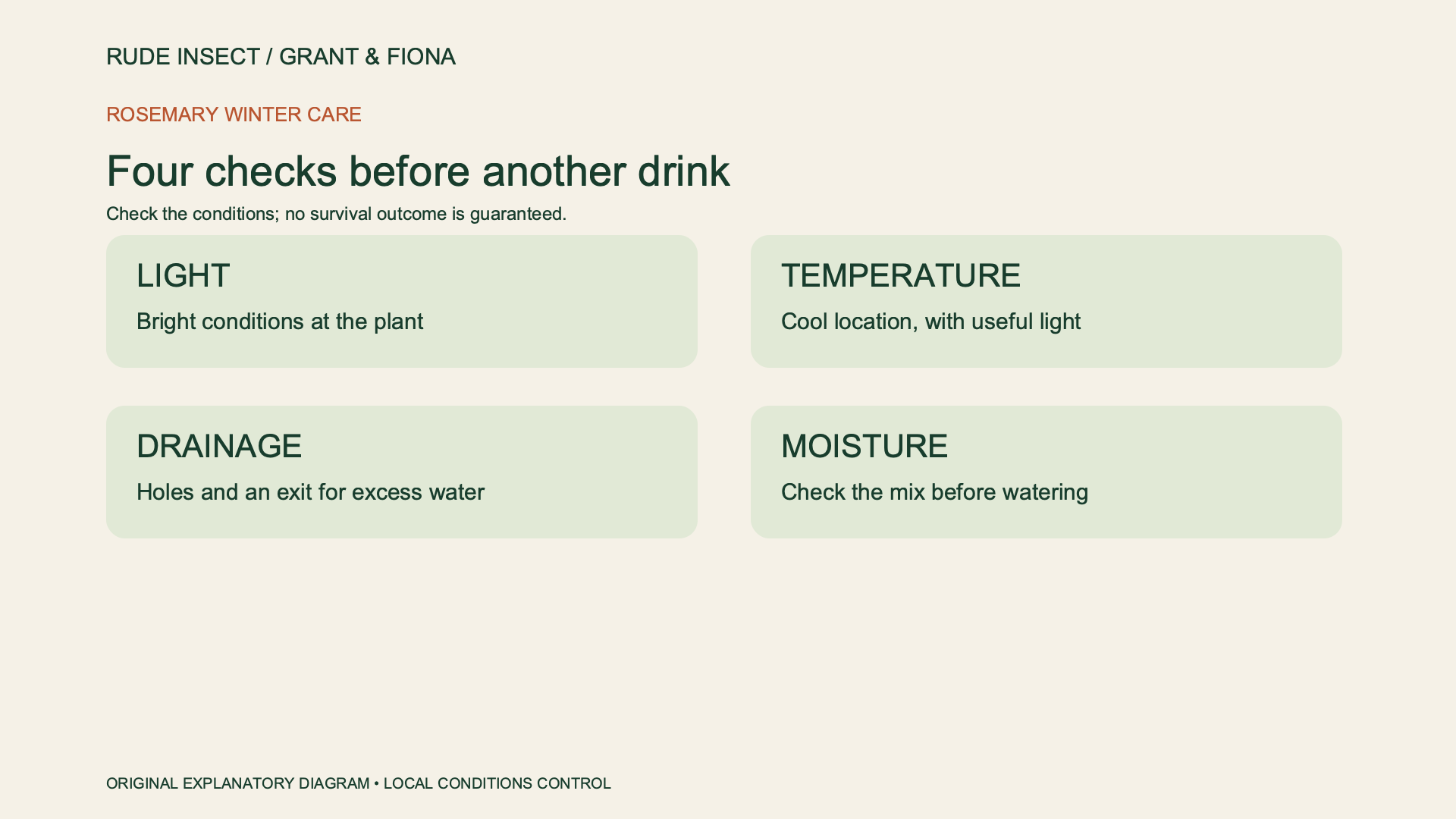
Give rosemary the brightest workable indoor location, keep it away from heating blasts and freezing conditions, and use a pot that drains freely. Check moisture beneath the surface before watering rather than following a calendar. Expect winter maintenance, not a steady supply of new sprigs.
For New England gardeners bringing a potted rosemary indoors for winter, University Extension guidance provides the foundation; the checklists below turn it into household decisions without assuming every window, pot, or rosemary cultivar behaves alike.
The scope is an existing container-grown rosemary brought indoors, not a promise of outdoor winter survival. New England’s coastal, inland, and elevated locations differ substantially. Cultivar hardiness also varies, and these sources do not establish outdoor survival limits for every named cultivar. An indoor care plan cannot settle that separate question.
The six-check winter care map
Use these checks in order before deciding that the plant needs more water, a larger pot, or another intervention.
| Check | Question to answer |
|---|---|
| Light | What light actually reaches the foliage? |
| Temperature | Is the location cool and protected, rather than hot or freezing? |
| Drainage | Can water leave both the growing pot and its outer container? |
| Moisture | What does the mix feel like beneath the surface? |
| Change | What changed before the plant’s appearance changed? |
| Harvest | Is new growth replacing the shoots being cut? |
1. Choose a location by light and temperature together
Do not choose between “bright” and “cool” without examining both. A dim basement is not a substitute for a bright room. Equally, a sunny shelf over a radiator may expose the pot to conditions quite different from the room’s thermostat reading.
Illinois Extension’s rosemary guidance describes a cool, very bright overwintering location, around 50–60°F. This is regional Illinois guidance, not a universal requirement, a cultivar hardiness rating, or a New England-specific guarantee.
Treat that range as a planning reference. Compare two or three realistic locations:
- A bright spare room where heating is lower.
- A sunny living-space window away from a heat outlet.
- An enclosed porch only if its overnight temperatures are known.
Measure temperature near the plant, especially overnight and during cold weather. A porch described as “protected” may still freeze. Keep foliage from touching cold glass, and check what happens when curtains close around the windowsill.
If your only bright room is warmer than the regional reference, do not move the plant into darkness just to lower its temperature. Work with the available light, investigate supplemental lighting if needed, and reassess drying in that actual location.
Choose somewhere accessible enough that checking the pot will remain practical in February.
2. Audit the light before changing anything else
A south-facing window is a useful starting point, not a measurement. Nearby buildings, evergreen trees, screens, curtains, and the plant’s distance from the glass affect its exposure.
Iowa State Extension’s indoor-herb guidance identifies light as a limiting factor. It gives four to six hours of direct sun as a general indoor-herb ideal and notes that rosemary may need supplemental full-spectrum LED or fluorescent lighting for 12–16 hours daily. These are planning guidelines, not proof that any fixture or window supplies enough light.
Try this observation exercise:
- On a reasonably clear day, check the proposed spot in the morning, near midday, and later in the afternoon.
- Note whether sunlight reaches the foliage itself, not merely the wall nearby.
- Record obvious shade from buildings or trees.
- Repeat after changing curtains or moving the pot.
If usable daylight is limited, assess whether a growing light can cover the plant safely. Follow the fixture’s instructions for placement; operating hours alone do not establish adequate light at the leaves. A timer can make the chosen daily duration consistent, and you can search Amazon for Soltech Vita grow light bulbs to compare pendant or lamp-compatible full-spectrum options for a single indoor pot.
Maryland Extension’s container and indoor-herb guidance likewise supports sunny locations, supplemental winter light, and reduced watering in cooler weather.
Lanky growth is a reason to review light, not a complete diagnosis. After changing lighting or location, check moisture again rather than continuing the old watering habit unquestioned.
3. Inspect the whole container, including what hides underneath
Drainage is a route, not just a hole. Water must leave the growing pot without accumulating around its base inside a decorative cover.
UNH Extension’s container-herb guide supports drainage holes and potting mix, cautions about oversized containers remaining wet, and identifies rosemary as preferring drier conditions than some other herbs.
Before the next watering:
- Lift the growing pot out of any decorative container.
- Look for standing water underneath.
- Confirm that drainage openings exist and are not pressed tightly against an impermeable surface.
- Note whether a small plant occupies a much larger volume of mix.
- Ask whether the container can be moved somewhere safe for watering and draining.
Do not automatically give a struggling plant a bigger pot. First establish what the current container is doing. Repotting changes several conditions at once and makes observation harder.
Iowa State also notes that clay containers dry more readily. That does not make clay mandatory: it means changing pot material can change your monitoring needs.
For broader layout decisions, the vertical-garden container-system comparison is a separate container-gardening resource. Comparing container systems is different from troubleshooting winter rosemary care. The link does not establish that any listed product was tested or is recommended for this purpose; accessible drainage and observation remain the priorities.
4. Replace watering dates with a repeatable decision
There is no dependable universal instruction to water indoor rosemary every particular number of days. A small pot near heating and a larger pot in a cool room can behave differently.
Minnesota Extension’s general herb guidance supports checking moisture beneath the surface and avoiding constantly soggy soil. Use that as an observation method, not an exact rosemary watering depth or interval.
Build a simple routine:
First, inspect the setting. Has the room become warmer? Has sunlight changed? Was the pot moved? Those details help explain why its drying pattern might differ.
Next, feel the mix beneath the surface. A dry-looking crust does not describe the whole pot. Check gently without repeatedly digging around the roots.
Then, lift the container if practical. Compare its weight with its own previous condition. Different pots are not useful weight comparisons.
Finally, decide whether to water. If the mix still feels damp, pause rather than adding water because it is a customary watering day. If it feels dry and the pot is noticeably lighter, watering may be appropriate.
When watering is needed, moisten the mix, let excess water drain, and empty the saucer or outer container. Confirm that water actually entered the mix rather than assuming runoff proves even wetting.
“Prefers drier conditions” does not mean “leave it dry indefinitely.” The objective is to follow the container’s changing moisture condition while avoiding persistent saturation. As Iowa State emphasizes, different herb species have different water needs; rosemary should not automatically share a basil or mint routine.
5. Keep a short record that helps you make decisions
A complicated journal is unnecessary. A few comparable observations can prevent repeated guesswork.
Use a note like this:
| Date | Location and light | Mix and pot weight | Action |
|---|---|---|---|
| First check | Window, heater nearby or absent | Damp or dry beneath surface; heavier or lighter | Watered, drained, or waited |
| Next check | Any change in position or lighting | Comparison with previous check | One adjustment, if needed |
Photograph the whole plant and its pot from a similar angle occasionally. Include the window or lighting arrangement in a separate photograph if you may seek advice.
Record actions as well as appearance. “Moved beside radiator, then watered twice” is more useful than “looks worse.”
Make one major adjustment at a time when practical, but do not postpone obvious corrections such as emptying standing water or moving the plant away from freezing conditions. The purpose is clearer observation, not rigid experimentation.
6. Match the next action to the situation, not leaf color
Yellowing, browning, wilting, or leaf loss does not, by itself, establish a disease or tell you whether to water. Use appearance as a prompt to inspect conditions.
The plant wilts, but the mix remains wet
Do not reflexively add another drink. Check the saucer, outer pot, drainage openings, and recent watering record. Note how long the mix has felt damp and whether the location is dim or cool.
Correct standing-water problems, then continue observing. This check does not identify the condition of the roots or diagnose an infection.
The pot is unusually light and the mix feels dry
Water if the moisture check supports it, allow drainage, and inspect whether the mix became moistened. Avoid repeatedly adding small amounts without checking the result.
Compare the pot’s weight afterward. That gives you a reference for future checks of this same container.
New growth is long, sparse, or strongly directed toward the window
Review usable light before making fertilizer the first response. Check for a curtain, changed position, or shading that was overlooked.
If adjusting a growing light, follow its placement instructions and record the change. Growth pattern alone does not establish a nutrient problem.
Leaves change color after a move
List what changed: light, temperature, heating exposure, pot, watering, or harvest. Check for visible insects or other material on the foliage without naming a pest from color alone.
If decline continues, contact a local Extension service with photographs and the care record. A cultivar name, if known, is useful context; it is not a diagnosis.
7. Set winter harvest expectations before reaching for scissors
UNH Extension’s winter indoor-herb discussion explains that rosemary growth slows during winter, limiting harvest.
Separate the goal of keeping the plant from the goal of stocking the kitchen. Existing foliage does not necessarily mean that replacement growth is keeping pace with cutting.
Before taking a sprig, ask:
- Has there been noticeable new growth since the previous harvest?
- Is the plant otherwise stable?
- Could this harvest wait?
Keep cutting modest when little replacement growth is visible. A winter with few usable sprigs can still be consistent with an overwintering goal.
Do not treat fertilizer as a universal rescue for slow growth. First review light, moisture, drainage, and the seasonal expectation. Those checks provide a better starting point than trying to force a harvest.
8. Plan for New England’s changing conditions, not one winter setting
A setup that seemed workable in autumn deserves another look during a cold spell and again as daylight increases. Heating use, window temperatures, and usable sunlight may change without the pot moving.
After a major weather or household change, repeat three checks:
- Temperature beside the plant, including overnight where relevant.
- Light reaching the foliage.
- Moisture beneath the surface and water beneath the pot.
Cultivar labels do not replace these observations. Without cultivar-specific evidence, do not assume that an upright or trailing form needs a different exact watering interval or can tolerate an unheated porch.
Iowa State places perennial herbs’ return outdoors in late spring when conditions are warm. For New England, use local forecasts and actual conditions rather than a universal calendar date. A warm afternoon alone does not establish that nights are suitable.
When an outdoor move becomes practical, plan a gradual change in exposure rather than treating indoor and outdoor conditions as interchangeable.
Start with the next check
Today, identify the brightest safe location, inspect the drainage route, and feel the mix beneath the surface. Write down what you find before changing the routine.
The useful winter question is not “What should I add?” but “Which condition can I verify?” Light, temperature, drainage, moisture, recent changes, and harvest pressure give you concrete places to start—without promising that every plant or home will respond identically.
Products in this guide
Soltech Vita Grow Light Bulb
Amazon search for Soltech Vita grow light bulb. Compare fixture wattage, beam angle, and safe mounting clearance over indoor herb containers before ordering.
Find matching listings on Amazon →Search results may include other models. Check the model and size before buying.