Can I Put Earthworms in My Compost Bin? Soil Worms vs. Red Wigglers
University extension guide comparing red wigglers vs soil earthworms, compost bin temperatures, moisture rules, and when to add worms.
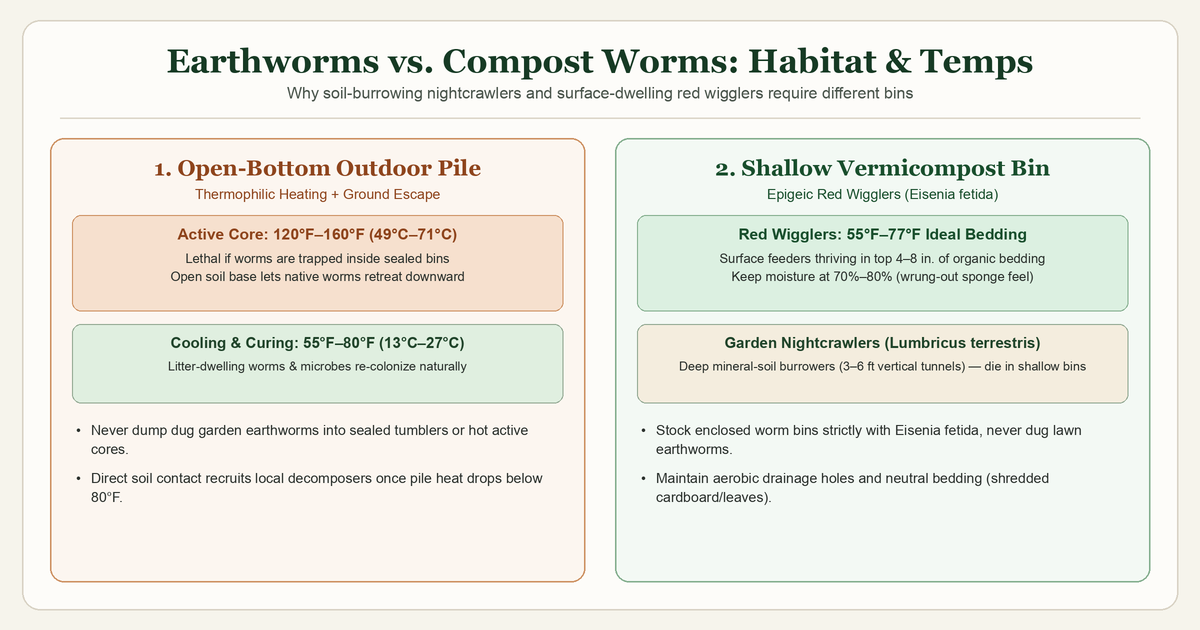
No—do not put common garden soil earthworms (Lumbricus terrestris or field nightcrawlers) into a closed compost bin, rotating compost tumbler, or indoor worm bin, and never add any worms to an actively heating thermophilic compost pile. Common garden earthworms are deep mineral-soil burrowers that suffocate, overheat, or starve in confined organic-matter bins. If your outdoor compost bin sits directly on bare soil, native surface-dwelling compost worms will migrate in naturally from the ground once the pile cools below 80°F (27°C). You only need to purchase and add specialized epigeic composting worms—specifically red wigglers (Eisenia fetida or Eisenia andrei)—when stocking a closed-bottom vermicomposting bin kept between 55°F and 77°F (13°C to 25°C).
Why “Earthworm” Does Not Mean One Single Type of Worm
When gardeners dig a spadeful of moist topsoil and uncover pale gray field worms or large reddish-brown nightcrawlers, the natural instinct is to toss a handful of those worms into the backyard compost bin to speed up breakdown. However, soil scientists and extension entomologists divide earthworms into three distinct ecological functional groups based on where they live in the soil profile, what they eat, and whether they build permanent burrows.
According to vermicomposting specialists at NC State Extension (Worms Can Recycle Your Garbage) and Oregon State University Extension (Composting with Worms, EM 9034), placing the wrong ecological class of worm into a compost container is the primary cause of worm die-offs and foul-smelling anaerobic bins.
| Ecological Category | Scientific & Common Examples | Natural Habitat Zone | Primary Diet & Feeding Behavior | Burrowing Habit | Survival in a Closed Compost or Worm Bin |
|---|---|---|---|---|---|
| Epigeic (Litter & Surface Dwellers) | Eisenia fetida, Eisenia andrei (Red Wigglers, Brandling Worms, Manure Worms) | Top 0 to 6 inches of decaying leaf litter, manure piles, and cool compost edges | High-organic-matter decaying plant scraps, bacteria, and fungi | No permanent burrows; move horizontally through loose organic bedding | Thrives in shallow vermicompost bins and cool outdoor piles (55°F–77°F) |
| Endogeic (Upper Mineral Soil Dwellers) | Aporrectodea caliginosa, Allolobophora chlorotica (Pale Field / Pasture Worms) | Top 4 to 20 inches of mineral topsoil around plant roots | Mineral soil mixed with decomposed humic matter and rhizosphere microbes | Horizontal, branching temporary burrows through mineral soil | Poor / Fails in pure organic compost without mineral soil structure |
| Anecic (Deep Vertical Burrowers) | Lumbricus terrestris (Common Nightcrawler / Dew Worm) | Deep vertical shafts 3 to 6 feet down into cool mineral subsoil | Pulls surface leaves down into permanent vertical mineral burrows | Permanent vertical burrows lined with mucus and castings | Dies rapidly in shallow bins, tumblers, or warm compost piles |
Why Garden Nightcrawlers Die in Compost Bins
Common nightcrawlers (Lumbricus terrestris) are anecic organisms evolved to live inside cool, insulated vertical shafts extending several feet into mineral clay and silt-loam subsoil. They rise to the soil surface only under the cover of cool, humid nights to grab fallen leaves and pull them back down into their burrows.
When you drop Lumbricus terrestris into a plastic compost tumbler or a shallow worm bin filled purely with shredded cardboard and kitchen scraps:
- No mineral soil exists for them to construct the mucus-lined vertical shafts required for their skin respiration and physical security.
- Ambient temperatures fluctuate rapidly, exceeding the cool 45°F to 60°F (7°C to 16°C) subsoil thermal range nightcrawlers require.
- Frequent turning or disturbance destroys their burrow architecture, triggering stress escape responses where worms crawl out through vent holes or die along the bin walls.
By contrast, epigeic red wigglers (Eisenia fetida) evolved specifically to colonize rich surface accumulations of decaying organic matter, forest litter, and aged livestock manure. They do not need mineral soil, tolerate crowded population densities of 1,000 to 2,000 worms per square foot of surface area, and process decaying vegetable matter rapidly in the top 4 to 6 inches of moist bedding.
The Temperature Barrier: Thermophilic Composting vs. Vermicomposting
Before introducing any worm species to a bin, distinguish between thermophilic (hot) composting and mesophilic vermicomposting. As explained in our complete beginner’s guide to backyard composting ratios and bins and Cornell Waste Management Institute composting science resources, an active outdoor compost pile built with a balanced 25:1 to 30:1 carbon-to-nitrogen ratio heats rapidly as thermophilic bacteria oxidize sugars and proteins.
   TEMPERATURE ZONES IN COMPOSTING vs. WORM SURVIVAL LIMITS
   ====================================================================
   160°F (71°C) +-----------------------------------------------------+
                | THERMOPHILIC SANITIZATION ZONE (131°F - 160°F)      |
                | Kills weed seeds & plant pathogens.                 |
   131°F (55°C) | INSTANTLY LETHAL to all earthworms & red wigglers.  |
                +-----------------------------------------------------+
                | MESOPHILIC HEATING / TRANSITION ZONE (90°F - 130°F) |
                | Active microbial breakdown.                         |
    90°F (32°C) | Worms flee immediately or suffer heat paralysis.    |
                +-----------------------------------------------------+
    85°F (29°C) | UPPER DANGER THRESHOLD FOR EISENIA FETIDA           |
                +-----------------------------------------------------+
    77°F (25°C) | OPTIMAL RED WIGGLER FEEDING ZONE (55°F - 77°F)      |
                | Maximum food processing and cocoon reproduction.    |
    55°F (13°C) +-----------------------------------------------------+
                | COOL SLOWDOWN ZONE (35°F - 54°F)                    |
                | Feeding slows; common nightcrawlers active at 45°F. |
    32°F  (0°C) +-----------------------------------------------------+
                | FREEZING THRESHOLD: Fatal to live adult red wigglers|
                | (Cocoons can survive brief light frosts in bedding).|
                +-----------------------------------------------------+
Why Sealed Tumblers Can Become Worm Traps
In an open-bottom compost bin or three-bin wooden bay sitting directly on bare garden soil, the center core of the pile can spike to 135°F to 155°F (57°C to 68°C) without killing native worms because the worms retreat downward into the cool underlying earth or outward to the cool outer 4-inch perimeter shell of the pile.
In an elevated rotating compost tumbler or a sealed-bottom plastic bin, there is no escape route into the ground. If a gardener adds fresh grass clippings, coffee grounds, and kitchen scraps to a tumbler sitting in afternoon sun, microbial respiration plus solar gain can push the interior drum temperature past 110°F to 140°F (43°C to 60°C) within 48 hours. Any worms trapped inside that sealed drum cannot escape the heat and perish quickly, creating a sour, putrid nitrogen spike.
To verify whether an outdoor bin has finished its hot thermophilic phase and entered the cool curing stage suitable for worms, insert a long-stem probe—comparable through an Amazon search for a REOTEMP 20-inch compost thermometer—into the center of the pile. Never add composting worms until the core temperature has remained steadily below 80°F (27°C) for at least seven consecutive days after turning.
Decision Matrix: When to Let Native Worms Migrate vs. When to Buy Red Wigglers
You do not need to buy worms for every composting setup. Use the following site-and-container comparison to decide whether to rely on natural colonization or purchase a dedicated starter pound of Eisenia fetida.
| Composting Setup Type | Contact With Bare Earth? | Typical Core Temperature Range | Should You Add Garden Soil Worms? | Should You Buy & Add Red Wigglers (Eisenia fetida)? | Recommended Management Strategy |
|---|---|---|---|---|---|
| Open-Bottom Wire Cylinder, Wood Pallet Bay, or Earth-Contact Plastic Bin | Yes (Direct soil interface) | 120°F–155°F during active phase; 55°F–80°F during curing | No (They will enter and exit the base boundary on their own) | Optional, only during the cool curing phase (<80°F) | Let microbes drive the hot phase; native litter worms and potworms will colonize from the soil automatically as the pile cools |
| Elevated Rotating Compost Tumbler | No (Suspended sealed drum) | 90°F–145°F in sun or with high-nitrogen loads; freezes in winter | Never | No (High risk of overheating in summer, freezing in winter, and crushing during rotation) | Run tumblers purely as microbial aerobic digesters; apply finished compost to garden beds where soil earthworms live |
| Dedicated Indoor / Garage / Shaded Porch Worm Bin (Stacking Tray or Tote) | No (Closed container with drainage/air vents) | Controlled 55°F–77°F year-round | Never (Soil worms die in shallow organic bedding) | Yes — Required (Stock 0.5 to 1.0 lb of Eisenia fetida per sq ft of surface area) | Maintain 4–6 inches of moist carbon bedding, feed buried vegetable scraps in small zones, and harvest vermicompost castings |
| In-Ground Trench Composting or Sub-Pod Buried Basket | Yes (Surrounded by garden bed soil) | Moderated by surrounding soil (50°F–75°F) | No need to dig and relocate them manually | Yes (In buried worm-tower baskets, red wigglers process kitchen scraps while local worms visit perimeter) | Keep buried feeder lid shaded and moist; avoid adding massive batches of lawn clippings that could heat up |
How to Stock and Manage a Closed Vermicompost Bin Correctly
If your goal is rapid processing of kitchen vegetable peelings, coffee grounds, and crushed eggshells inside a closed bin—or if you want nutrient-dense vermicompost (worm castings) to top-dress seedlings and raised beds—set up a dedicated epigeic worm bin rather than tossing worms into a hot yard-waste pile.
According to University of Maryland Extension (Indoor Worm Composting / Vermicomposting) and Cornell Cooperative Extension vermicomposting guidelines, successful worm bin management depends on five measurable environmental parameters:
1. Surface Area Matters More Than Bin Depth
Because Eisenia fetida are surface-dwelling epigeic feeders that congregate in the top 4 to 6 inches (10 to 15 cm) of bedding, a wide, shallow bin supports far more active worms than a deep, narrow barrel.
- Target depth: 8 to 14 inches total bin depth, with bedding maintained at 4 to 8 inches deep.
- Rule of thumb for sizing: Provide 1 square foot of bin surface area per pound of kitchen food scraps generated per week. A standard 18-gallon shallow storage tote or commercial stacking tray (~2 to 3 square feet of surface area) comfortably handles 2 to 3 pounds of vegetable scraps per week once populated with 1,000 to 2,000 red wigglers (1 to 2 pounds of worms), which you can compare via an Amazon search for Uncle Jim’s Worm Farm red wiggler composting worms.
2. Carbon Bedding Preparation and the “Wrung Sponge” Moisture Test
Worms breathe directly through their moist outer cuticle (skin). If bedding dries below 60% moisture, worms dehydrate and stop feeding; if water pools at the bottom and fills all air pores (>85% moisture), oxygen diffusion stops, anaerobic bacteria produce organic acids and hydrogen sulfide, and worms flee upward onto the lid.
Build the initial bedding layer from high-carbon materials soaked in clean water and squeezed until only 1 to 2 drops of water emerge when clenched firmly in your fist (70% to 80% moisture by weight):
- Shredded non-glossy corrugated cardboard and black-and-white newspaper strips (1/2 to 1 inch wide).
- Shredded autumn deciduous leaves (oak, maple, beech—screened for twigs).
- Rinsed, buffered coconut coir fiber or aged, cooled horse/cow manure compost.
- Grit addition: Mix 1 to 2 tablespoons of pulverized agricultural limestone (calcium carbonate), rock dust, or finely ground baked eggshell powder per square foot of bedding. Worms lack teeth and rely on fine mineral grit inside their muscular gizzard to grind food particles, while calcium carbonate buffers the organic acids released during food decay to keep bin pH near 6.5 to 7.0.
3. Pocket Feeding Discipline and Foods to Exclude
The number-one mistake in new worm bins is overfeeding before the microbial biofilm and worm population adjust. Under optimal 65°F to 75°F conditions, red wigglers consume roughly 25% to 50% of their body weight in decaying food scraps per day once established—not 100% on day one.
   ROTATING POCKET-FEEDING PATTERN (TOP VIEW OF SHALLOW WORM BIN)
   +------------------------------------------------------------+
   |  [ Zone 1: Week 1 ]          |  [ Zone 2: Week 2 ]         |
   |  Bury 1 cup chopped scraps   |  Bury next feeding here     |
   |  under 2 in. dry/moist       |  ONLY after Zone 1 scraps   |
   |  carbon bedding              |  are 75%+ consumed          |
   |------------------------------+-----------------------------|
   |  [ Zone 4: Week 4 ]          |  [ Zone 3: Week 3 ]         |
   |  Leaves central escape space |  Always cover every feeding |
   |  if one pocket heats slightly|  with 2 in. clean carbon    |
+------------------------------------------------------------+- Feed in rotating corners (Pocket Feeding): Pull back 2 inches of bedding in one quadrant, bury a thin layer of chopped kitchen scraps mixed with a handful of dry shredded cardboard or leaves, and cover it completely with 2 inches of clean bedding. Wait until 75% of that pocket disappears before burying food in the next quadrant.
- Safe Worm Bin Inputs: Vegetable trimmings, fruit peelings (melon rinds, apple cores, banana peels), coffee grounds and unbleached paper filters, plain tea bags (staples removed), crushed eggshells, and wilted garden greens.
- Keep Out of Worm Bins: Meat, poultry, fish, dairy, fats/oils, salty or heavily spiced cooked leftovers, dog or cat feces, glossy coated cardboard, fresh green grass clippings in thick layers (which heat up rapidly and release ammonia), and large quantities of raw citrus rinds or raw onion/garlic skins (which contain d-limonene and sulfur compounds that irritate worm skin in confined spaces).
Identifying Worm Bin Guests: White Potworms vs. Black Soldier Fly Larvae
Gardeners checking an outdoor compost pile or indoor worm bin frequently spot other pale wriggling organisms and wonder whether their earthworms reproduced or died.
| Organism Seen in Bin | Visual Appearance & Size | What It Indicates About Bin Conditions | Action Required |
|---|---|---|---|
| Red Wiggler Juveniles (Eisenia fetida) | Translucent pinkish-red threads, 1/4 to 3/4 inch long, clearly visible blood vessels; hatch from lemon-shaped amber cocoons | Healthy reproduction at 60°F–77°F with balanced moisture and food | None—keep bedding moist and continue moderate pocket feeding |
| Potworms / Enchytraeids (White Compost Worms) | Tiny, pure white threads (1/8 to 1/2 inch long) clustering on wet bread, fruit, or sour pockets | Bedding is too wet (>80% moisture) and slightly acidic (pH < 6.0) from starch/fruit fermentation | Fluff bedding, mix in dry shredded cardboard, pause feeding for 7 days, and dust lightly with pulverized eggshell or garden lime |
| Black Soldier Fly Larvae (Hermetia illucens) | Plump, segmented, cream-to-dark-brown grubs (1/2 to 1 inch long) with tough leathery skin; no distinct legs | High-nitrogen food scraps in warm weather (75°F–95°F) with outdoor fly access | Harmless rapid decomposers in outdoor bins, but can outcompete red wigglers and raise bin heat/moisture; bury food under 3 inches of dry carbon or screen vents |
| Fungus Gnats / Fruit Flies | Small flying adults hovering when lid opens; tiny translucent maggots with black head capsules on exposed fruit | Exposed fruit scraps on surface and overly wet top bedding layer | Freeze fruit scraps before adding, bury all food under 2–3 inches of dry shredded cardboard/coir, and place a breathable cardboard blanket over the bedding surface |
Step-by-Step Checklist Before Adding Any Worm to a Bin
- Identify the Worm Species: Never relocate deep-burrowing garden nightcrawlers (Lumbricus terrestris) or pale pasture worms from dug garden soil into a closed bin. Use Eisenia fetida (red wigglers) for closed vermicomposting.
- Check Ground Contact: If your outdoor compost bin has an open bottom sitting on bare earth, save your money—keep the pile moist and balanced, and native epigeic worms will move up from the soil interface once heating subsides.
- Measure Core Temperature: Verify with a compost thermometer that the pile or bedding is between 55°F and 77°F (13°C to 25°C) and never above 80°F (27°C).
- Verify Moisture and Drainage: Perform the wrung-sponge squeeze test on the bedding and confirm that bottom drainage holes or aeration vents are open and unobstructed.
- Bury a Small Test Feeding: Place new red wigglers on top of pre-moistened, cooled carbon bedding under a bright light for 15 minutes so they burrow down out of the light, then wait 3 days before burying their first small corner pocket of vegetable scraps.
Products in this guide
REOTEMP Backyard Compost Thermometer
Amazon search for REOTEMP 20-inch stem compost thermometer. Compare stem length, dial temperature zones, and sheath durability before ordering.
Find matching listings on Amazon →Search results may include other models. Check the model and size before buying.
Uncle Jim's Worm Farm Red Wiggler Composting Worms
Amazon search for live Eisenia fetida red wiggler composting worms. Verify species identification, shipping temperature guarantees, and bed weight before ordering.
Find matching listings on Amazon →Search results may include other models. Check the model and size before buying.