How to Suppress Grass With Arborist Wood Chips: Depth, Nitrogen & Sheet Mulching Guide
How deep to layer fresh arborist wood chips to smother lawn grass, manage stolon weeds, and protect soil nitrogen without weed fabric.
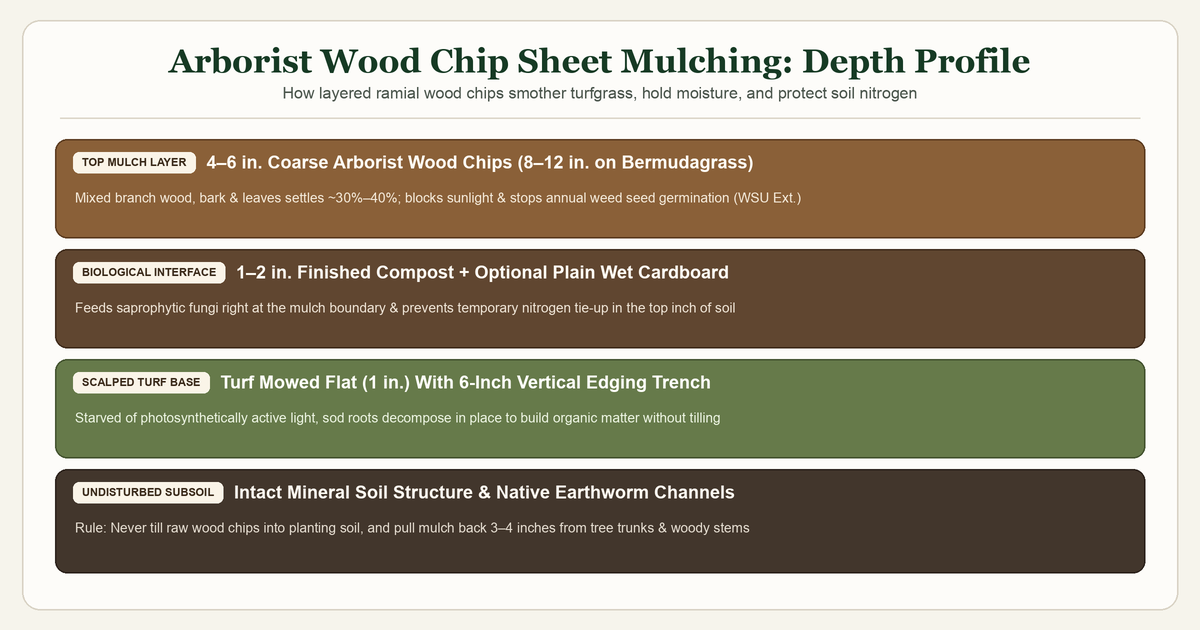
To suppress cool-season lawn grass (such as Kentucky bluegrass, tall fescue, or perennial ryegrass) with arborist wood chips, scalp the turf as low as possible, cut a 6-inch vertical edge trench around the perimeter, and apply an unsettled layer of coarse arborist wood chips 4 to 6 inches deep (10 to 15 cm). If you are smothering aggressive warm-season stoloniferous or rhizomatous grasses—such as bermudagrass (Cynodon dactylon), quackgrass (Elymus repens), or field bindweed—increase the initial wood-chip depth to 8 to 12 inches or pair a 6-inch wood-chip blanket with an underlying layer of wet, overlapped, tape-free corrugated cardboard and a 1-to-2-inch finished compost buffer on the soil surface. Never bury wood chips inside the root zone, and skip synthetic landscape fabric, which traps silt above the plastic where new weeds root within two seasons.
Why Fresh Arborist Wood Chips Outperform Bagged Bark Mulch for Grass Suppression
Not all woody mulches behave the same way over turfgrass. As horticultural scientist Dr. Linda Chalker-Scott explains in Washington State University Extension Fact Sheet FS160E (Using Arborist Wood Chips as Landscape Mulch), arborist wood chips (also called ramial chipped wood when derived from branches) are the mixed material produced when tree-care crews chip pruned branches, trunks, twigs, bark, and green leaves together.
Compared against commercial bagged bark mulch or dyed shredded pallet wood, fresh arborist wood chips offer distinct physical and biological properties for smothering grass and building soil:
| Mulch Material Type | Chemical & Structural Composition | Physical Packing Behavior | Soil Moisture & Fungal Activity | Effectiveness at Smothering Turfgrass |
|---|---|---|---|---|
| Fresh Arborist Wood Chips (Mixed wood, bark, twigs, leaves) | Cellulose, hemicellulose, lignin, plus soluble sugars and nitrogen from green cambium and leaves | Diverse particle sizes knit together lightly while maintaining coarse air and water pores | Rapidly colonized by beneficial saprophytic basidiomycete fungi and mycorrhizae; absorbs rain freely | High at 4–6 inches (or 8–12 in. on rhizomes); blocks light while resisting wind/rain washout |
| Bagged Pine or Fir Bark Nuggets / Shredded Bark | Mostly outer tree periderm (80%+ suberin/waxes and hydrophobic tannins) | Repels water when dry, floats away in heavy rain, and compacts into water-shedding mats | Low cellulose content limits fungal food web; slower humic conversion | Moderate to Poor; lightweight nuggets shift easily, exposing gaps where grass blades emerge |
| Dyed Shredded Recycled Wood (Pallet / Demolition Grindings) | Dry heartwood lacking bark, cambium, or foliage; coated with iron oxide or carbon dyes | Uniform fine splinters mat down or blow away; very high carbon-to-nitrogen ratio (~400:1+) | Minimal biological diversity; potential preservative contamination if sourced from unverified scrap | Poor for turf conversion; requires underlying barrier and breaks down slowly without feeding soil life |
| Sawdust or Fine Wood Shavings | Extremely fine particle size (<2 mm) with high surface-area-to-volume ratio | Packs tightly when wet, sealing off oxygen exchange and shedding light rain | High surface area causes rapid microbial nitrogen immobilization at the soil boundary | Not recommended at deep conversion thicknesses; creates anaerobic crusting |
For a broader overview of where wood chips belong across pathways, orchards, and vegetable beds, compare our pillar guide on wood chip mulch pros and cons.
Matching Wood Chip Depth to Your Grass Species and Weed Pressure
A common reason sheet mulching fails is applying a cosmetic 2-inch mulch layer over vigorous lawn grass. Two inches of wood chips acts like a fertilizer blanket for established turf: the grass blades push right through the shallow gaps into the sunlight, and now enjoy cooler, moister roots free from competition.
According to University of Maryland Extension (Weed Management Without Chemicals) and University of Minnesota Extension mulching guidelines, freshly dumped arborist wood chips contain significant air space and settle by 30% to 40% of their initial volume within the first 4 to 8 weeks as rain packs the chips and fungal mycelium binds the lower layer. Always measure your initial installation depth knowing that a 6-inch loose pile settles to roughly 3.5 to 4 inches of settled coverage.
| Existing Vegetation Type | Root & Shoot Architecture | Minimum Initial Loose Wood-Chip Depth | Settled Target Depth | Should You Use Wet Overlapped Cardboard Underneath? | Expected Time to Complete Turf Death |
|---|---|---|---|---|---|
| Cool-Season Bunch & Mild Sod Grasses (Tall fescue, perennial ryegrass, fine fescue, Kentucky bluegrass) | Shallow fibrous root mat (top 2–4 in.) and short rhizomes | 4 to 6 inches (10–15 cm) | 3 to 4 inches | Optional (Helpful in spring when grass carbohydrate reserves are highest; unnecessary at 6 in. chip depth in late summer/autumn) | 6 to 10 weeks during active growing temperatures |
| Broadleaf Lawn Weeds & Annuals (Crabgrass, dandelion, plantain, chickweed, clover) | Taproots or shallow nodes; seeds require light flash at soil surface to germinate | 4 to 6 inches (10–15 cm) | 3 to 4 inches | Optional | 4 to 8 weeks (Occasional taproot sprouts pull easily from loose damp chips) |
| Aggressive Warm-Season Stolon & Deep Rhizome Grasses (Bermudagrass, Johnsongrass, Quackgrass, Kikuyugrass, Torpedograss) | Deep starch-storing rhizomes and wiry horizontal stolons capable of tunneling 12–24+ inches laterally in darkness | 8 to 12 inches (20–30 cm) during conversion phase | 5 to 7 inches | Recommended (Use 2 overlapping layers of wet, tape-free corrugated cardboard with 8-inch seam overlaps underneath the chips) | 3 to 6 months; requires strict perimeter trench maintenance to stop lateral re-invasion |
| Deep Perennial Rhizome Broadleaves (Field bindweed Convolvulus arvensis, Canada thistle, horsetail, goutweed) | Brittle roots extending 3 to 10+ feet deep with massive carbohydrate reserves | 6 to 8 inches + repeated hand-pulling of emerging etiolated shoots | 4 to 5 inches | Avoid permanent barriers (Bindweed travels along cardboard seams; straight deep wood chips make it easy to pull pale weakened shoots weekly until roots exhaust reserves) | 1 to 2 full growing seasons of persistent shoot removal |
Does Fresh Wood Chip Mulch “Steal” Nitrogen From Your Soil?
Gardeners often worry that spreading fresh green tree chips directly from an arborist’s dump truck will lock up all the nitrogen in the underlying soil and turn plants yellow. Soil science and extension field trials show a much more precise reality: nitrogen immobilization occurs only inside the thin 0.5-inch (1 cm) contact boundary where woody carbon directly touches mineral soil—and only becomes a serious problem if you till or mix wood chips into the root zone.
   NITROGEN DYNAMICS UNDER SURFACE WOOD CHIPS vs. TILLED WOOD CHIPS
   ======================================================================
   [ CORRECT: SURFACE MULCH LAYER ]              [ WRONG: INCORPORATED / TILLED IN ]
   +-----------------------------------+         +-----------------------------------+
   | 4–6 in. Arborist Wood Chips       |         | Wood chips mixed throughout top   |
   | (C:N ratio ~60:1 to 200:1)        |         | 6–8 inches of root-zone soil.     |
   +-----------------------------------+         |                                   |
   | 1–2 in. Finished Compost Buffer   |         | Soil bacteria coat every buried   |
   | (Supplies N right at interface)   |         | chip interface, immobilizing      |
   +-----------------------------------+         | soluble nitrate (NO3-) and        |
   | Undisturbed Topsoil & Root Zone   |         | ammonium (NH4+) right where       |
   | --> Earthworms carry humic carbon |         | shallow vegetable roots feed.     |
   |     downward; net soil N rises!   |         +-----------------------------------+
   +-----------------------------------+
How to Prevent Interface Nitrogen Tie-Up on Day One
- Spread a 1-to-2-Inch Layer of Finished Compost Beneath the Chips: Before dumping your 4 to 6 inches of arborist wood chips over scalped grass (or over your cardboard layer), spread 1 to 2 inches of screened finished compost, aged manure, or alfalfa meal/organic lawn fertilizer directly across the soil or sod surface. This nitrogen-rich layer accelerates decomposition of the buried grass roots and feeds the white-rot and brown-rot fungi colonizing the bottom of the wood chips so they never draw nitrate out of the mineral soil below.
- Pull Wood Chips Back When Planting Small Transplants or Seeds: Deep wood chips suppress grass primarily by blocking light and creating a coarse, low-nutrient physical layer where fine weed seeds desiccate before their radicles reach mineral soil. That exact same mechanism will stunt vegetable seeds or shallow annual transplants if you plant them directly into raw wood chips. When planting into a wood-chip bed:
- Rake the wood chips back in a 6-to-8-inch circle to expose the dark underlying soil and compost layer.
- Plant your transplant root ball directly into the mineral soil/compost zone (never mixing raw wood chips into the planting hole).
- Keep wood chips 2 to 3 inches away from tender herbaceous stems and 3 to 4 inches away from woody shrub and tree trunks so constant bark moisture does not invite crown rot (Phytophthora) or rodent chewing in winter.
Step-by-Step Sheet Mulching Protocol to Convert Lawn Into Garden Beds
Converting 200 to 1,000 square feet of lawn takes heavy bulk material: covering 100 square feet to a 6-inch initial depth requires approximately 1.85 cubic yards (50 cubic feet) of loose arborist wood chips. Moving that volume efficiently requires a wide-head 10-tine bedding/mulch fork—which you can compare via an Amazon search for a 10-tine welded steel mulch pitchfork—rather than a flat dirt shovel that catches and binds on woody twigs.
Step 1: Scalp the Grass and Cut a Vertical Perimeter V-Trench
Set your lawnmower to its lowest deck notch (1.0 to 1.5 inches) and mow the target area flat, leaving the nitrogen-rich grass clippings in place on the ground. Next, use a flat-blade edging spade—comparable through an Amazon search for a flat-blade steel edging spade—to cut a clean 6-inch-deep V-shaped trench around the entire outside border where the new wood-chip bed meets remaining lawn.
   PERIMETER V-TRENCH EDGE DETAIL (BLOCKS LATERAL RHIZOME INVASION)
   Remaining Lawn Turf         Air Gap / Vertical Cut      New Wood-Chip Bed
   ^^^^^^^^^^^^^^^^^^^^\                 |                 /====================
   Grass Roots (3-4")   \                v                / 4-6" Arborist Chips
   ----------------------\               /               /----------------------
                          \_____________/_______________/ 1-2" Compost Interface
                          6-Inch Deep V-Trench (Keep exposed or fill with coarse
                          chips; clean out with flat spade twice per summer)
More than 80% of long-term grass invasion in wood-chip beds comes from surrounding lawn rhizomes and stolons creeping sideways across the border, not from smothered grass growing straight up through 6 inches of chips. A 6-inch vertical edge trench creates an air gap where creeping stolons poke out into open air and can be severed in minutes with a flat spade twice a season.
Step 2: Water the Scalped Sod Thoroughly
Dry soil pauses biological decomposition. Before laying down any compost, cardboard, or wood chips, soak the scalped turf until the top 4 inches of soil are thoroughly moist. Earthworms, fungi, and soil bacteria require moisture to consume the dying sod roots beneath the mulch blanket.
Step 3: Apply the Nitrogen/Compost Interface (and Optional Cardboard Layer)
- Direct Wood-Chip Method (Preferred by WSU Extension for maximum gas exchange): Spread 1 to 2 inches of finished compost directly over the wet, scalped sod, then proceed immediately to applying 6 inches of coarse arborist wood chips.
- Sheet-Mulch Cardboard Method (Helpful for spring bermudagrass/quackgrass suppression): Strip all plastic packing tape, shipping labels, and staples off plain brown corrugated cardboard boxes. Lay the sheets down with at least 6 to 8 inches of overlap at every seam so grass blades cannot angle toward a crack of daylight. Hose the cardboard down until it is saturated and conforms flexibly to the ground contours, then spread 1 inch of compost on top of the wet cardboard so it stays damp and decomposes within 3 to 5 months.
Step 4: Spread 4 to 6 Inches of Fresh Arborist Wood Chips and Soak Again
Dump wheelbarrows of arborist wood chips across the bed and rake them level with the back of a bow rake to a uniform 4 to 6 inches (or 8 to 12 inches over bermudagrass). Water the top of the wood-chip layer thoroughly to settle dust, lock fine particles into the matrix, and initiate fungal colonization.
Common Questions About Sourcing and Using Arborist Wood Chips
Are wood chips from diseased trees or black walnut (Juglans nigra) safe to use?
- Diseased landscape trees: Exhaustive trials summarized by WSU Extension FS160E demonstrate that root pathogens (such as Verticillium or Armillaria) do not infect healthy landscape trees when wood chips are applied strictly as a surface mulch above the soil line and kept back from bruised trunks. The aggressive saprophytic fungi that feast on fresh wood chips outcompete and digest plant pathogens inside the mulch layer.
- Black walnut (Juglans nigra) chips: Black walnut tissues contain juglone, an allelopathic compound that can inhibit sensitive shallow-rooted annuals (particularly tomatoes, peppers, eggplants, and potatoes) when fresh walnut leaves, bark, and hulls are used directly around them. Allow pure black walnut chip loads to age and compost in a pile for 6 months (where aerobic microbes degrade juglone), or reserve fresh walnut-heavy loads for ornamental woodland paths away from solanaceous vegetable beds.
Do wood chips attract termites right up to a house foundation?
Subterranean termites forage in moist soil regardless of whether wood chips, gravel, or landscape fabric sits on top. However, to comply with structural pest-inspection guidelines from university entomology departments, never pile wood chips directly against house siding, stucco, or wooden sill plates. Maintain a clean 12-to-18-inch pebble or bare mineral-soil inspection strip immediately adjacent to house foundations, and start deep arborist wood-chip beds beyond that foundation clearance zone.
Products in this guide
Truper Tru Pro 10-Tine Ensilage & Mulch Pitchfork
Amazon search for 10-tine welded steel mulch and bedding pitchfork. Compare tine spacing, head width, and D-grip handle strength before ordering.
Find matching listings on Amazon →Search results may include other models. Check the model and size before buying.
Fiskars Steel Long-Handle Edging Spade
Amazon search for flat-blade steel edging spade for cutting V-trench lawn borders. Compare blade thickness, foot step, and handle length before ordering.
Find matching listings on Amazon →Search results may include other models. Check the model and size before buying.