Natural Plant Insect Repellent: What Works in Vegetable Gardens (Extension IPM Guide)
Compare evidence-backed natural plant insect repellents, companion planting limits, and botanical sprays using extension IPM guidance.
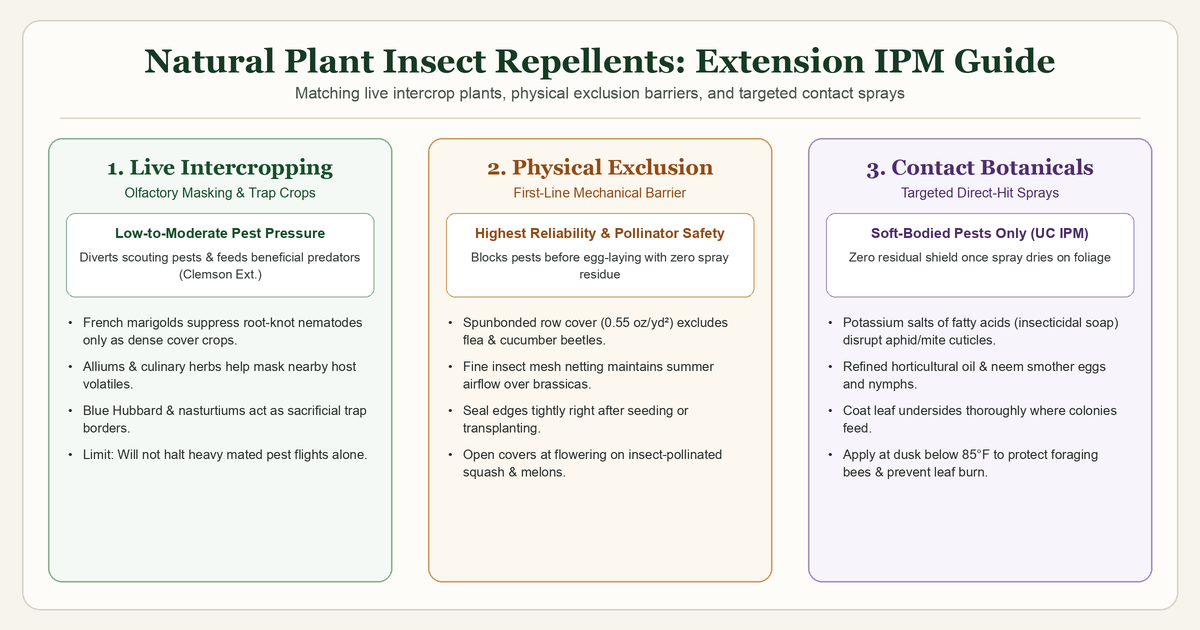
No single “natural plant insect repellent” creates an invisible force field that keeps all garden pests out of a vegetable bed, nor does planting basil or marigolds on a patio automatically stop mosquitoes from biting people. In university extension Integrated Pest Management (IPM), plant-based pest suppression works through three distinct, measurable mechanisms: live intercropping and trap plants that mask host-plant odors or recruit predatory insects, physical exclusion barriers (floating row covers and fine insect mesh) that block egg-laying adults mechanically, and targeted botanical or soap contact sprays (azadirachtin/neem oil, potassium salts of fatty acids, horticultural oil, and pyrethrins) that must physically coat soft-bodied pests to work while requiring dusk application to protect bees.
Separating Garden Folklore From Extension Entomology
Search listings and social media graphics routinely promise that placing a pot of citronella grass (Cymbopogon nardus), lavender, or peppermint next to a tomato plant—or beside a deck chair—repels aphids, hornworms, squash bugs, and mosquitoes across an entire yard. University entomologists have tested these claims extensively and draw a sharp line between extracted essential oils concentrated in a laboratory and intact leaves sitting quietly on a living plant.
As documented by Clemson Cooperative Extension (HGIC 2756: Companion Planting) and University of Minnesota Extension integrated pest management guides, intact aromatic plants release only trace concentrations of volatile organic compounds (terpenes, linalool, citronellal, or thymol) into the surrounding breeze unless their leaves are crushed or distilled. Wind dilutes those volatiles within inches of the leaf surface. Consequently:
- Mosquitoes vs. intact “mosquito plants”: Citronella-scented geraniums (Pelargonium citrosum), lemon balm, and catnip do not repel mosquitoes simply by growing in a pot nearby; entomological trials show mosquitoes frequently land directly on intact “mosquito plant” leaves unless the concentrated essential oil is extracted, formulated correctly, and applied at labeled concentrations.
- Vegetable pests vs. scattered border herbs: Tucking two marigold seedlings at the corner of a 4x8 raised bed will not stop mated female cabbage white butterflies (Pieris rapae), squash vine borers (Melittia cucurbitae), or Colorado potato beetles (Leptinotarsa decemlineata) from locating their host crops.
However, when used with the right biological target and planting density, live plants and plant-derived compounds perform specific, documented functions inside a broader vegetable companion planting layout and integrated garden pest control system.
Mechanism 1: Live Intercropping, Olfactory Masking, and Insectary Plants
Herbivorous insects locate their preferred vegetable hosts using two primary sensory cues: olfactory plumes (specific volatile chemicals emitted by brassicas, cucurbits, or solanaceous crops) and visual contrast (green foliage silhouetted against bare brown soil). Live companion and insectary plants disrupt pest colonization through four documented pathways:
| Botanical Strategy | Representative Plants | Documented Pest / Beneficial Target | Biological Mechanism Confirmed by Extension Research | Practical Limitation to Plan Around |
|---|---|---|---|---|
| Root Exudate Allelopathy (Cover Cropping) | French Marigolds (Tagetes patula, e.g., ‘Single Gold’, ‘Nemagold’) | Root-knot nematodes (Meloidogyne spp.) in warm sandy soils | Living roots exude alpha-terthienyl, which suppresses nematode hatching and root penetration when grown as a dense solid stand for 2–3 months before the vegetable crop | Does not repel above-ground foliar beetles; ineffective if only planted as sparse border edging |
| Volatile Olfactory Masking & Visual Disruption | Alliums (chives, garlic, scallions) and aromatic Lamiaceae herbs (thyme, rosemary, sage, cilantro) interplanted among carrots or lettuce | Carrot rust fly (Psila rosae), green peach aphid (Myzus persicae), flea beetles | Disrupts low-flying host-finding insects that rely on pure monoculture scent plumes and bare-soil visual contrast | Overwhelmed if pest populations are already established on transplants |
| Perimeter Trap Cropping | Blue Hubbard winter squash around summer zucchini; Nasturtiums (Tropaeolum majus) near brassicas or beans | Squash bugs (Anasa tristis), striped/spotted cucumber beetles, black bean aphids | Concentrates incoming pests onto a more chemically attractive sacrificial perimeter plant where eggs and adults can be destroyed | Backfires if the gardener fails to inspect and remove/treat pests on the trap crop before they disperse to the main bed |
| Floral Nectar & Pollen Insectary Habitat | Sweet alyssum (Lobularia maritima), dill, fennel, coriander, yarrow, cosmos | Adult hoverflies (Syrphidae), insidious flower bugs (Orius insidiosus), lacewings, parasitic braconid wasps | Shallow-throated umbel and crucifer flowers feed adult beneficial insects whose larvae devour aphids, thrips, and small caterpillars | Takes 7 to 14 days for beneficial predator numbers to catch up with a sudden spring aphid flush |
How French Marigolds Actually Suppress Nematodes
One of the most misunderstood garden practices is how marigolds (Tagetes species) protect crops. As explained by University of Florida IFAS Extension (Marigolds for Nematode Management, ENY-056), marigolds do not emit an airborne gas that chases insects out of a garden bed. Instead, specific varieties of French marigold (Tagetes patula) and African marigold (Tagetes erecta) produce a sulfur-containing compound called alpha-terthienyl inside their root tissues.
To achieve measurable suppression of root-knot nematodes (Meloidogyne incognita), marigolds must be seeded as a dense, weed-free solid cover crop (spaced no more than 6 to 8 inches apart) across the entire bed for a full 60 to 90 days before planting susceptible tomatoes, okra, or cucurbits in that spot. Simply placing four marigold plants between tomato cages leaves 90% of the soil volume untreated.
Mechanism 2: Physical Exclusion Replaces Chemical Repellents
When university extension specialists design low-spray organic vegetable plots, their first line of defense against chewing beetles and boring moths is mechanical exclusion—putting a physical barrier between the adult insect and the host leaf before eggs are laid.
   TIMING PHYSICAL EXCLUSION vs. POLLINATION WINDOWS
   ======================================================================
   1. NON-FRUITING LEAF & ROOT CROPS (Kale, Cabbage, Broccoli, Radish,
      Arugula, Spinach, Swiss Chard, Carrots, Beets):
      [ Transplant / Seed ] === Keep Under Row Cover / Mesh All Season ===> [ Harvest ]
      * No insect pollination required; blocks cabbage worms, flea beetles & leafminers 100%.

   2. INSECT-POLLINATED FRUITING CROPS (Zucchini, Winter Squash, Cucumbers,
      Melons, Pumpkins):
      [ Transplant / Seed ] === Cover Tightly Until First Female Bloom ===> [ Open for Bees ]
      * Protects vulnerable seedlings during peak spring cucumber beetle & vine borer flight.
   ======================================================================
Selecting Between Spunbonded Row Cover and Woven Insect Mesh
- Lightweight Spunbonded Polypropylene Row Cover (e.g., 0.55 oz/yd²): Transmits roughly 85% of available sunlight while sealing edges against 1/16-inch flea beetles, cabbage root maggot flies, and imported cabbageworm butterflies. You can compare roll widths and weights through an Amazon search for Agribon AG-19 floating row cover. Because spunbonded fabric traps 2°F to 4°F of radiant warmth, it excels in spring and autumn; in midsummer heat above 85°F, switch to open-weave polyethylene insect netting (0.6 mm to 0.8 mm mesh) so heat does not accumulate under the hoop tunnel.
- Soil-Line Stem Collars: For cutworms and cabbage maggot flies, a simple 3-inch cardboard collar pushed 1.5 inches into the soil around the transplant stem—or a flat 5-inch square of landscape felt slit to hug the base of a brassica stem—blocks females from depositing eggs in the root crown crack without spraying a drop of pesticide.
Mechanism 3: Plant-Derived and Mineral Contact Sprays (UC IPM Guidelines)
When pest numbers exceed your threshold and physical covers are impractical, organic growers turn to plant-derived (botanical) or mineral/fatty-acid sprays. A critical principle emphasized by UC IPM (University of California Statewide Integrated Pest Management Program — Less-Toxic Insecticides) is that most natural and organic sprays are contact materials with almost zero residual activity once dry. Spraying healthy empty leaves “preventively” once a week does not repel tomorrow’s beetles; it only wastes material and risks scorching tender foliage.
| Active Ingredient | Mode of Action on Target Pest | Effective Target Pests | Ineffective Against | Phytotoxicity & Pollinator Safety Rules |
|---|---|---|---|---|
| Potassium Salts of Fatty Acids (Insecticidal Soap) | Penetrates soft insect cuticles and disrupts cell membrane integrity on direct wet contact | Aphids, spider mites, whitefly nymphs, mealybugs, soft scales, psyllids | Hard-shelled adult beetles (flea beetles, Japanese beetles), large caterpillars, unhatched eggs | Never spray when temperatures exceed 85°F (29°C) or plants are drought-stressed; coat leaf undersides thoroughly; safe once dry |
| Clarified Hydrophobic Extract of Neem Oil vs. Azadirachtin | Hydrophobic oil suffocates mites/eggs on contact; Azadirachtin acts as an insect growth regulator (molting inhibitor) and antifeedant | Aphids, whiteflies, thrips, spider mites, early-instar leaf-chewing larvae | Fast-moving adult beetles and mature late-instar hornworms or squash bugs | Check the product label: “Clarified hydrophobic extract of neem oil” has had azadirachtin removed and acts only as a smothering oil; do not apply within 24 hours of sulfur sprays |
| Bacillus thuringiensis var. kurstaki (Btk) | Naturally occurring soil bacterium crystal protein that paralyzes caterpillar midguts ONLY when ingested | True caterpillars (Lepidoptera larvae: cabbage loopers, imported cabbageworms, tomato hornworms) | Aphids, beetles, sawfly larvae, squash bugs, spider mites | Completely non-toxic to bees, lady beetles, birds, and mammals; apply in evening as UV sunlight degrades Btk protein on leaves within 48–72 hours |
| Spinosad (Fermentation product of Saccharopolyspora spinosa) | Contact and ingestion neurotoxin targeting insect nicotinic acetylcholine receptors | Caterpillars, Colorado potato beetle larvae, thrips, leafminers, flea beetles | True bugs (adult squash bugs, stink bugs) and sucking aphids | Toxic to foraging honeybees and native bees while wet (and for 3 hours after drying); never spray open blossoms; apply strictly at dusk |
| Botanical Pyrethrins (Chrysanthemum cinerariifolium extract) | Rapid contact sodium-channel knockdown of insects hit directly by spray droplets | Broad spectrum of exposed soft and hard insects present at the moment of application | Hidden borers inside stems, eggs, or insects arriving 2 hours later (breaks down rapidly in sunlight) | Broad-spectrum non-selective: kills beneficial lady beetles, lacewings, and bees on contact; use only as a targeted last resort at dusk |
| Kaolin Clay Particle Film | Fine white mineral film creates a gritty visual and tactile barrier on leaves | Cucumber beetles, flea beetles, squash bugs, apple maggot, leafhoppers | Aphids multiplying underneath un-coated lower leaves | Must be reapplied after heavy rain; wash powdery white clay film off leafy greens and fruit at harvest |
Why Homemade Dish Detergent Sprays Damage Vegetable Leaves
Many online recipes substitute liquid kitchen dishwashing detergent for true horticultural insecticidal soap. As extension horticulturists at Clemson Extension (HGIC 2771: Insecticidal Soaps for Garden Pest Control) warn, household dish detergents are synthetic surfactants engineered to strip grease from cookware and frequently contain degreasers, antibacterial agents, fragrances, and dyes. Spraying dish detergent onto tomato, bean, cucumber, or squash foliage strips the protective epicuticular wax layer right off the leaf epidermis, causing necrotic brown leaf burn (phytotoxicity).
True insecticidal soaps—which you can compare via an Amazon search for OMRI-listed Safer Brand Insect Killing Soap Concentrate—use purified long-chain potassium salts of fatty acids (specifically C18 oleic acid chains) selected for high toxicity to soft-bodied insect membranes and low phytotoxicity to plant cuticles when diluted with soft water according to label instructions.
Five-Step Extension IPM Protocol for Low-Spray Vegetable Beds
Rather than looking for a miracle repellent plant, combine cultural, physical, and biological layers in this sequence:
- Sanitation and Crop Rotation First: Remove spent crop debris in autumn so overwintering squash bugs, flea beetles, and cucumber beetles lose their shelter adjacent to next spring’s beds. Rotate plant families so brassicas, cucurbits, and solanaceous crops do not occupy the exact same bed in consecutive years where possible.
- Interplant Insectary Umbels and Alyssum Along Bed Edges: Dedicate 5% to 10% of your raised bed corners to continuous-blooming sweet alyssum, dill, and coriander so adult hoverflies, lacewings, and parasitic wasps reside permanently inside your garden before aphid colonies appear.
- Cover Vulnerable Seedlings Immediately at Planting: Hoop lightweight floating row cover or fine insect mesh over brassicas, radishes, eggplants, and young cucurbits the afternoon you seed or transplant them, burying or clamping all four edges flush to the bed frame.
- Scout Leaf Undersides Twice Weekly: Flip over the lowest and newest leaves on 5 to 10 plants twice a week. Use a firm stream of water from a garden hose nozzle in the morning to knock early aphid clusters off sturdy stems, and hand-crush orange-bronze squash bug egg masses on leaf undersides using painter’s tape.
- Apply Targeted Contact Sprays Only at Dusk When Thresholds Are Crossed: If soft-bodied pests outpace predators, spray the exact infested leaf undersides with diluted potassium fatty-acid soap or neem oil after sunset when temperatures are between 60°F and 80°F, wind is calm, and pollinators have returned to their hives and nests for the night.
Products in this guide
Agribon AG-19 Floating Row Cover
Amazon search for Agribon AG-19 lightweight spunbonded floating row cover. Compare fabric weight, width, and light transmission rating before ordering.
Find matching listings on Amazon →Search results may include other models. Check the model and size before buying.
Safer Brand Insect Killing Soap Concentrate
Amazon search for OMRI-listed potassium salts of fatty acids insecticidal soap. Verify active ingredients, dilution rates, and crop label instructions before ordering.
Find matching listings on Amazon →Search results may include other models. Check the model and size before buying.