Overwintering Peppers & Herbs Indoors: Grow Light & Pruning Setup
University extension guide to pruning, pest-checking, and lighting potted peppers and culinary herbs indoors through winter.
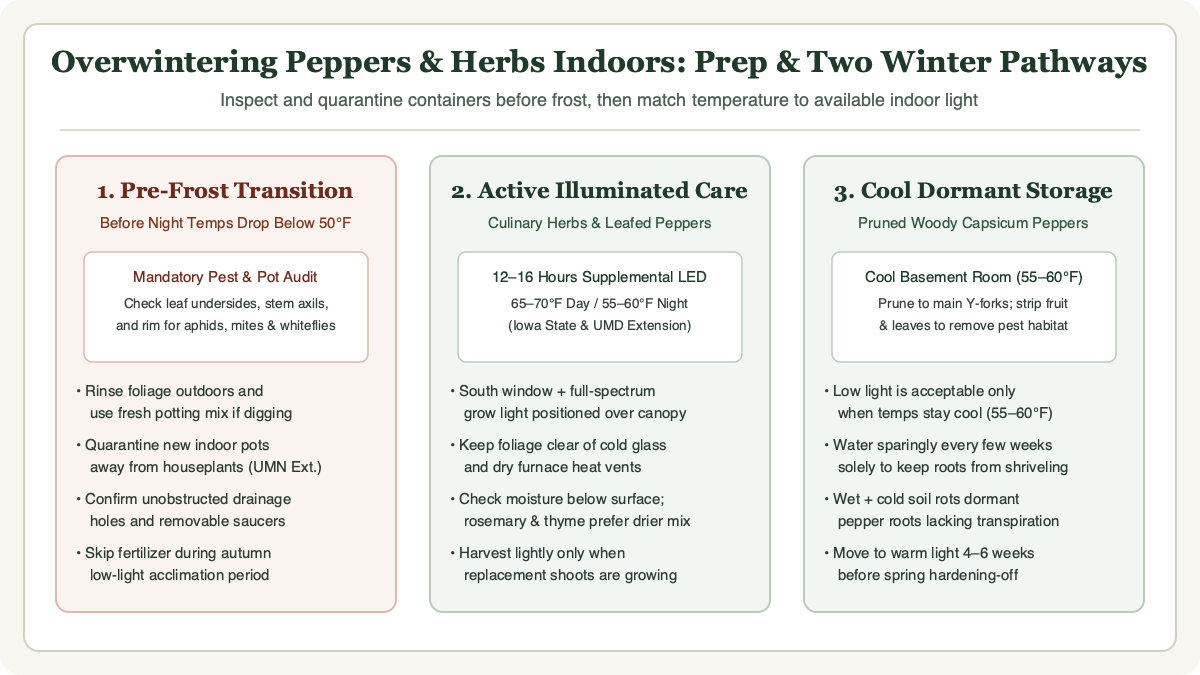
Successfully overwintering peppers indoors—alongside tender perennial culinary herbs like rosemary, thyme, oregano, chives, and mint—starts before the first autumn frost: inspect every leaf underside for aphids, spider mites, and whiteflies, wash the foliage outdoors, and quarantine incoming containers away from existing houseplants. Next, choose the overwintering pathway that matches your indoor temperature and lighting: either keep leafy herbs and active pepper plants under 12 to 16 hours of supplemental full-spectrum grow light at 65°F to 70°F by day (55°F to 60°F at night), or prune woody pepper stems back to their main structural forks for semi-dormant storage in a cool 55°F to 60°F room with minimal watering.
Why Peppers and Certain Culinary Herbs Can Be Overwintered Indoors
Although home gardeners in frost climates usually grow hot and sweet peppers (Capsicum annuum, Capsicum chinense, Capsicum baccatum, Capsicum frutescens, and Capsicum pubescens) as single-season annuals, pepper plants are botanically tender perennials native to warm tropical and subtropical regions. As horticultural specialists on Ask Extension explain, container-grown pepper plants do not die on a fixed autumn calendar; they die outdoors when freezing temperatures kill their frost-tender tissues. When brought indoors before frost and protected from pests and root rot, an established pepper plant preserves its mature woody rootstock and branching structure, allowing it to resume flowering and fruiting weeks earlier the following spring than newly sown seedlings.
Culinary herbs require a similar distinction between life cycle and winter management. According to Iowa State University Extension and University of Maryland Extension, herbs brought indoors for winter fall into different biological groups:
- Perennial woody and herbaceous herbs—such as rosemary, thyme, oregano, sage, mint, chives, French tarragon, and bay laurel—naturally persist from year to year. They can be dug and potted from garden beds in late summer or transitioned indoors in their existing containers before hard freezes arrive.
- Tender annual or biennial herbs—such as sweet basil, cilantro, dill, and parsley—are much better started fresh indoors from seed or stem cuttings in autumn rather than digging up old, woody, flowering outdoor plants at the end of summer.
Recognizing which plants you are keeping—and whether your goal is active winter kitchen harvests or simply keeping mature rootstocks alive until May—prevents the most common winter failure: placing a large, heavily leafed outdoor plant into a dim, warm living room and watering it on a July schedule.
Choosing Between Active Grow-Light Care and Cool Dormant Storage
Before carrying pots across the threshold, decide which of the two overwintering regimes fits each plant and the rooms available in your home. Temperature, light intensity, foliage volume, and water demand are tightly linked: a warm plant demands bright light to support respiration, whereas a cool, pruned plant in semi-dormancy uses very little light or water.
| Overwintering Pathway | Best Candidate Plants | Target Room Temperature | Daily Light Requirement | Pruning & Foliage State | Winter Watering Routine |
|---|---|---|---|---|---|
| Pathway A: Active Illuminated Growth | Culinary herbs (rosemary, thyme, oregano, chives, parsley, young basil) & compact fruiting peppers | 65°F – 70°F Day / 55°F – 60°F Night (avoid hot furnace blasts) | Bright south window plus 12–16 hrs/day supplemental LED or fluorescent grow light | Light shaping only; retain healthy green canopy for photosynthesis and modest snipping | Water thoroughly only when mix feels dry below surface; empty saucer immediately |
| Pathway B: Cool Semi-Dormant Overwintering | Mature, woody hot or sweet pepper plants (Capsicum spp.) stored purely for spring replanting | 55°F – 60°F steady cool basement, spare room, or heated frost-free sunporch | Low to moderate indirect light or a modest shop light (do not force lush growth in cool dim air) | Strip remaining fruit, flowers, and leaves; prune branches back to 2–3 nodes above main “Y” forks | Water sparingly every 2–3 weeks just enough to prevent root ball desiccation; never keep cold soil wet |
Reference: Compiled from overwintering recommendations by Iowa State University Extension, University of Maryland Extension, University of New Hampshire Extension, and Ask Extension.
Step 1: Timing the Move and Acclimating Plants Before Frost
Do not wait until the evening of a 28°F freeze forecast to drag containers straight from the patio into a heated 70°F living room. Pepper plants suffer chilling injury and leaf drop when night temperatures repeatedly dip below 50°F, while tender herbs like basil show cold damage even in the mid-40s.
Iowa State University Extension and University of Maryland Extension recommend starting the indoor transition in late summer or early autumn while outdoor night temperatures are still above 45°F to 50°F:
- Dig and pot garden-bed plants early: If a pepper or perennial herb is growing in the ground rather than a container, dig it up and pot it into clean, well-draining container mix at least two to three weeks before bringing it inside. Let the newly potted plant recover from root disturbance in a shaded, sheltered outdoor spot before subjecting it to lower indoor light and humidity.
- Step down light exposure gradually: Outdoor sunlight is several times brighter than even the sunniest south-facing window. Moving a plant from full outdoor sun into a shaded porch or dappled outdoor spot for 7 to 10 days—or bringing it indoors at night and setting it in partial shade by day—reduces the shock of sudden light drop. Expect some older outdoor “sun leaves” to yellow and drop during the first two weeks indoors as the plant adjusts.
Step 2: Mandatory Pest Inspection, Washing, and Quarantine
Outdoors, natural predators (lady beetles, lacewings, parasitic wasps, and hoverflies), wind, and rain keep sap-sucking insects in check. Indoors, those natural controls vanish while warm, dry house air accelerates pest reproduction. A single unnoticed gravid female aphid on a pepper stem can multiply into a sticky honeydew infestation covering every windowsill plant by December.
According to University of Minnesota Extension, the primary pests hitchhiking indoors on garden containers include aphids, two-spotted spider mites, whiteflies, scale insects, mealybugs, and fungus gnats (whose larvae feed on fungi and organic matter in consistently damp potting mix).
Before any pepper or herb pot enters your main living or growing space, complete this four-part sanitation protocol:
- Inspect high-risk hiding zones with a magnifier: Check the undersides of young terminal leaves, stem axils (where petioles meet main stems), flower buds, and under the rim and drainage holes of the pot. Look for tiny clustering aphids, fine webbing and stippled leaves (spider mites), or white moth-like insects that flutter up when foliage is tapped (whiteflies).
- Wash foliage and stems outdoors: Use a gentle stream of water from a garden hose or sink sprayer to dislodge insects, dust, and spider mites from both the upper and lower surfaces of the leaves. Allow the foliage to dry thoroughly before nightfall.
- Clean the container and replace garden soil: Never bring scoopfuls of raw outdoor garden soil indoors; field soil compacts poorly in pots and harbors earthworms, slugs, centipedes, weed seeds, and root pests. If repotting an inground pepper for dormant overwintering, gently shake or rinse loose field soil from the roots and repot into fresh, sterile, porous potting mix in a scrubbed container with unobstructed drainage holes.
- Quarantine incoming plants for 2 to 4 weeks: University of Minnesota Extension advises isolating newly brought-in plants in a separate room away from your permanent houseplant collection for several weeks. Inspect the quarantine pots twice a week under bright light so any hatching aphid or whitefly cohort can be washed off or treated according to label directions before spreading.
Step 3: How to Prune Peppers and Herbs for Winter Survival
Pruning serves two completely different purposes depending on whether you chose Pathway A (active grow-light care) or Pathway B (cool semi-dormant storage).
Pruning Peppers for Cool Semi-Dormant Overwintering (Pathway B)
If you are storing a prized habanero, jalapeño, bell, or heirloom pepper in a cool basement room (55°F–60°F) without high-intensity grow lights, leaving a full summer bush of leaves on the plant invites spider mites and water stress. Follow the dormant pruning approach outlined by Ask Extension horticultural educators:
- Harvest all remaining ripe and mature-green fruit and pinch off any lingering flowers or buds. Ripening fruit drains carbohydrates that the woody stems and roots need for winter survival.
- Identify the main structural “Y” forks where the central stem divides into two or three primary scaffold branches (typically 6 to 8 inches above the soil line).
- Use clean, alcohol-wiped bypass pruners to cut each primary branch back to 1 to 2 inches (roughly two to three outward-facing nodes) above that first or second main “Y” junction, removing all thin upper twigs.
- Strip the remaining leaves (or leave only a tiny tuft of newly emerging inner leaves if the room has moderate light). Removing the old outdoor foliage eliminates the vast majority of hiding aphid eggs, thrips, and spider mites right at the door and dramatically lowers transpiration so the root ball needs very little water.
Pruning Peppers and Culinary Herbs for Active Grow-Light Care (Pathway A)
If you are placing a compact pepper plant or a tray of rosemary, thyme, oregano, and chives directly under an indoor grow light to keep green foliage alive all winter, do not strip the plant bare:
- Remove any yellowing, damaged, or insect-stippled lower leaves and thin out crowded interior twigs so light and air can penetrate the center of the canopy.
- On leggy outdoor herbs such as oregano, mint, or thyme, trim overgrown stems back by roughly one-third to encourage compact lateral shoots under the grow light.
- On woody rosemary, never cut into old, brown, leafless hardwood at the base of the plant, as woody rosemary stems rarely break new buds from bare old wood; trim only within the green, leafy tips.
- For chives, Iowa State University Extension notes a distinct physiological requirement: dig a clump of chives in autumn, pot it up, let it experience a cool/frost period outdoors (or in a cold garage/frame) to satisfy its dormancy requirement, and then bring it into warm indoor light where it will push fresh green spears.
Step 4: Setting Up Indoor Grow Lights, Distance, and Photoperiod
Short winter days and low sun angles—especially across the northern United States and New England—make window light alone insufficient for active herb growth or leafy peppers between November and February. As University of New Hampshire Extension and Iowa State University Extension explain, even an unobstructed south-facing window in midwinter provides far fewer hours and lower intensity of photosynthetically active radiation (PAR) than plants received in summer.
While windowsill herbs ideally need at least 4 to 6 hours of direct sunlight, most indoor setups require 12 to 16 hours per day of supplemental artificial lighting run on an automatic outlet timer.
Matching the Fixture Type to Your Container Layout
For a full breakdown of shelf bars versus single-pot fixtures, refer to our cluster pillar guide on selecting plant light systems for seedlings, herbs, and houseplants. In summary, match the light geometry to your containers:
- Multi-pot herb trays on a rack: A 2-foot or 4-foot full-spectrum LED shop light or horticultural bar fixture spreads even illumination across a row of 6-inch herb pots. Under standard low-heat fluorescent or linear LED bars, University of Maryland Extension and Iowa State University Extension note keeping tubes roughly 4 to 6 inches (up to 6 to 12 inches for higher-output LEDs) above the top of the herb foliage.
- Single large pepper pot or standalone rosemary container: A linear shelf bar often does not fit over a tall 3-gallon or 5-gallon pepper pot standing in a living area. Here, a high-output screw-in full-spectrum LED grow bulb mounted in a pendant cord or adjustable gooseneck floor lamp allows you to position light directly over the tall canopy. You can search Amazon listings for Soltech Vita grow light bulbs to compare wattage options, narrow vs. wide beam spread angles, and manufacturer clearance guidelines (typically mounted 12 to 24 inches above the canopy depending on wattage and beam lens) before ordering.
Regardless of fixture style, plug the light into a grounded 24-hour mechanical or digital timer set for 14 hours on and 10 hours off. Plants require a consistent daily dark period for normal metabolic processes, and manual switching inevitably leads to skipped days.
Step 5: Winter Watering, Drainage, and Why You Should Skip Fertilizer
Overwatering in cool, low-light winter conditions kills more overwintered peppers and Mediterranean herbs than cold temperatures ever do.
Both University of Maryland Extension and University of New Hampshire Extension emphasize three rules for winter moisture and nutrition:
- Check moisture below the surface before every watering: Never water on a fixed weekly schedule. Push a finger 1 to 2 inches into the potting mix and lift the pot to judge its weight. Mediterranean woody herbs (rosemary, thyme, sage, oregano) and pruned semi-dormant peppers must dry significantly in the upper couple of inches between waterings. When you do water, moisten the root zone and immediately empty any standing water from the drainage saucer within 15 minutes.
- Group plants by moisture demand, not in one shared planter: Do not plant rosemary or thyme in the same container as moisture-loving mint, parsley, or basil. Keep each species in its own pot with drainage holes so you can water each container according to its actual drying rate.
- Withhold or drastically reduce fertilizer during midwinter: Because indoor winter growth is slow—and semi-dormant peppers are barely growing at all—adding full-strength nitrogen fertilizer in December or January forces weak, succulent, aphid-prone shoots and builds up soluble salts in the potting mix. Wait until late winter (late February or March), when natural day length increases and active new spring shoots appear, before applying a diluted (quarter- to half-strength) balanced water-soluble fertilizer.
Waking Plants Up in Late Winter and Hardening Off in Spring
Around 4 to 6 weeks before your local last spring frost date, move semi-dormant pepper pots out of their cool 55°F–60°F storage room into a warm (68°F–72°F) area under bright grow lights or a sunny south window. Water the root ball moderately and watch for tiny green buds swelling along the woody “Y” branches. Once active leaf growth is underway, resume light feeding and pinch back any overly long, spindly shoots to encourage bushy branching.
Wait to move overwintered peppers and tender herbs permanently outdoors until nighttime temperatures stay reliably above 50°F to 55°F and all frost danger has passed. Just as in autumn, acclimate the plants gradually over 7 to 14 days (“hardening off”): start with 1 to 2 hours of outdoor shade protected from wind, and add an hour or two of filtered sun each day. Indoor leaves grown under LEDs or window glass lack the thick waxy cuticle needed to withstand direct midday UV light and spring wind; rushing a plant straight onto a sunny patio will bleach and scorch its foliage within a single afternoon.
Frequently Asked Questions
Should I prune all the leaves off my pepper plant to overwinter it indoors?
It depends on your overwintering method. If you are storing the pepper plant semi-dormant in a cool (55°F to 60°F), lower-light basement or spare room, pruning the branches back to the main “Y” forks and removing the old leaves and fruit is recommended because it eliminates hidden pests like aphids and spider mites and minimizes water loss. If you are keeping the pepper actively growing at room temperature under a dedicated grow light for 12 to 16 hours a day, keep healthy foliage and only lightly shape the canopy.
How many hours of grow light do indoor herbs and peppers need in winter?
According to Iowa State University Extension and University of Maryland Extension, culinary herbs and active indoor container plants perform best with 12 to 16 hours of supplemental full-spectrum fluorescent or LED light per day when natural winter sunlight falls short of 4 to 6 hours of direct sun. Use a plug-in timer so the plants receive a consistent day length and an uninterrupted 8- to 10-hour night period.
Why did my overwintered pepper or herb get covered in sticky residue and tiny bugs indoors?
Sticky droplets (“honeydew”) on leaves and windowsills are excreted by sap-feeding insects—most commonly aphids, whiteflies, or soft scale—that came indoors unnoticed on the plant when it was moved from the garden. Because indoor rooms lack outdoor predators and rain, small pest populations multiply rapidly. Isolate the affected pot immediately, wash the foliage thoroughly with water, and inspect leaf undersides twice weekly.
How often should I water dormant pepper plants in the winter?
A pruned, leafless pepper plant held in a cool 55°F to 60°F room has almost no leaf surface area losing water to transpiration, so its roots take up moisture very slowly. Check the potting mix every 10 to 14 days and apply only a small amount of water every two to three weeks—just enough to keep the deeper root ball barely damp so roots do not shrivel. Cold, soggy soil will quickly rot dormant pepper roots.
Which garden herbs are easiest to keep alive indoors over winter, and which should be started fresh?
Perennial herbs such as chives, mint, oregano, thyme, and rosemary are good candidates for overwintering in individual pots with strong light and careful drainage, while annual or biennial herbs like sweet basil, cilantro, dill, and parsley are much easier to grow indoors by starting fresh seeds or rooting healthy stem cuttings rather than digging up tired, woody outdoor plants in late fall.
Products in this guide
Soltech Vita Grow Light Bulb
Amazon search for Soltech Vita grow light bulbs. Compare wattage, beam spread, and fixture clearance over potted peppers and herbs before ordering.
Find matching listings on Amazon →Search results may include other models. Check the model and size before buying.